Three marks
Define Ethics, Personal Ethics and Professional Ethics.
Define following terms. 1. Ethics.2. Personal Ethics.3. Business Ethics.(summer-3)
Define the following terms: (1) Professional Ethics (2) Morality (3) Values (summer-3)
Define professional ethics.(summer-3)
- Ethics:
- Ethics refers to the study of moral principles that govern individuals' behavior, guiding them in distinguishing between right and wrong actions.
- In a broader sense, ethics involves the application of these principles to various aspects of life, including personal conduct, interpersonal relationships, and professional activities.
- Personal Ethics:
- Personal ethics encompasses an individual's own moral values, beliefs, and principles that guide their behavior and decision-making in personal and social contexts.
- It reflects an internal code of conduct shaped by personal experiences, cultural influences, and individual convictions.
- Professional Ethics:
- Professional ethics pertains to the moral principles and standards that govern the conduct of individuals within a specific professional or occupational context.
- It outlines the expected behaviors, responsibilities, and ethical considerations relevant to a particular profession, ensuring that practitioners adhere to a set of shared values and norms.
- Professional ethics helps maintain integrity, trust, and accountability within a professional setting.
- Business Ethics:
- Business ethics refers to the moral principles and standards that guide the behavior of individuals and organizations in the business environment.
- It involves making ethical decisions and conducting business activities in a manner that is fair, transparent, and responsible. Business ethics encompasses a wide range of issues, including honesty, integrity, corporate social responsibility, and fair treatment of stakeholders.
- Morality:
- Morality refers to an individual's understanding of right and wrong.
- It plays a crucial role in guiding decisions and actions based on principles and values.
- For example, if faced with a decision that could harm others for personal gain, a person guided by strong moral principles would prioritize ethical behavior, even if it means personal sacrifice.
- Values:
- Values are core beliefs or principles that individuals consider important and use as guiding standards for their behavior. They represent what someone sees as significant and worthwhile in life, influencing choices and actions.
- Values contribute to personal identity, shaping an individual's character and influencing how they interact with others and navigate life's challenges.
Define following terms: Utilitarianism, Virtue, Fairness and Justice.
Utilitarianism:
- Utilitarianism is a moral theory that says the best action is the one that maximizes overall happiness or utility for the greatest number of people.
- It focuses on the consequences of actions rather than rigid moral rules.
Virtue:
- Virtue refers to good moral qualities or characteristics in a person, such as honesty, kindness, or integrity.
- Virtue ethics emphasizes the development of positive character traits to guide behavior.
Fairness:
- Fairness means treating everyone justly and without favoritism, ensuring that decisions and actions are impartial and reasonable.
- Fairness involves considering individual needs and circumstances to ensure equitable treatment.
Justice:
- Justice involves fairness, equity, and the proper application of the law, ensuring that individuals receive what they deserve and are treated with fairness in society.
- Justice also includes addressing systemic inequalities and promoting a just distribution of resources.
What do you mean by Karma? Explain Law of Karma.
What is the law of karma?(summer-3)
Karma:
- Karma is a concept from Hinduism and Buddhism, saying every action has consequences. The word "karma" means "action" or "deed."
Key Aspects of the Law of Karma:
- Action and Consequence:
- Every action, good or bad, has results. Good actions lead to good outcomes, and bad actions lead to problems.
- Cause and Effect:
- Karma works like a seed growing into a plant—actions cause results. What we do now affects our future.
- Reincarnation and Samsara:
- Karma is linked to the cycle of life, death, and rebirth. Actions today can impact future lives in this cycle called Samsara.
- Moral Accountability:
- Karma means being responsible for our actions. Doing good things, like kindness, brings positive results. Doing bad things, like harming others, brings problems.
- Liberation and Freedom:
- Karma isn't fate. It lets us grow and be free from suffering. Doing good things helps us spiritually evolve and find freedom (moksha).
Explain codes of personal ethics for Employees.
- Codes of personal ethics for employees are sets of guidelines or principles that outline the expected behavior and conduct of individuals within an organization.
- These codes serve as a framework to help employees make ethical decisions and navigate various situations in the workplace. Here's an explanation of key aspects related to codes of personal ethics for employees:
- Confidentiality and Privacy:
- Emphasis on protecting sensitive information and respecting privacy in dealings with colleagues and clients.
- Conflict of Interest:
- Guidance on recognizing and managing situations where personal interests may conflict with professional duties.
- Compliance with Laws:
- Encouragement for employees to adhere to relevant laws and regulations in their professional activities.
List outs Latest Technologies used for disaster management.
- Geographic Information Systems (GIS):
- Remote Sensing:
- Drones and Unmanned Aerial Vehicles (UAVs):
- Early Warning Systems:
- Artificial Intelligence (AI) and Machine Learning (ML):
- Social Media and Crowdsourcing:
- Mobile Applications:
- Big Data Analytics:
- Blockchain Technology:
- Augmented Reality (AR) and Virtual Reality (VR):
- Internet of Things (IoT):
- Crisis Mapping:
- Communication Technologies:
- 3D Printing:
Enlist at least four characteristics of quality of working life. How alternate work schedules helps to improvise and achieve standard quality of working life?
Four Characteristics of Quality of Working Life:
- Achieving work-life balance is crucial for a high quality of working life.
- Job security contributes to a positive working experience and reduces stress.
- A safe and healthy work environment enhances overall well-being at work.
- Access to training and career opportunities improves job satisfaction and working life.
- Alternate work schedules, including flexible hours and remote work, can significantly contribute to improving the quality of working life:
Impact of Alternate Work Schedules:
- Flexibility and Autonomy:
- Alternate work schedules empower employees with the flexibility to choose when and where they work, enhancing overall well-being.
- Reduced Commuting Stress:
- Remote work and flexible hours alleviate commuting stress, positively impacting employees' well-being and quality of working life.
- Increased Job Satisfaction:
- Offering alternate work schedules demonstrates commitment to employee well-being, leading to higher job satisfaction and engagement.
- Enhanced Work-Life Balance:
- Alternate work schedules support a healthier work-life balance, allowing employees to tailor their hours to individual needs for an improved quality of working life.
Justify: “Beauty lies in the eye of the beholder and thus one must accept the way it is” correlates the law of humility of karma.
- The statement "Beauty lies in the eye of the beholder, and thus one must accept the way it is" correlates with the law of humility in the context of karma.
- The law of humility in karma emphasizes acceptance, understanding, and acknowledgment of the diverse perspectives and experiences of individuals. Here's how the statement aligns with this law:
- Subjective Beauty Acknowledgment:
- Recognizing beauty as subjective aligns with humility in karma, promoting acceptance of diverse views and respecting each person's unique perspective.
- Non-Judgmental Stance:
- Accepting subjective beauty encourages avoiding judgments, echoing humility in karma's call for openness and understanding in approaching situations.
- Respecting Diverse Views:
- Valuing various opinions on beauty aligns with humility in karma, emphasizing understanding and acknowledging the validity of each person's experiences.
- Letting Go of Ego:
- Embracing diverse beauty opinions requires humility—letting go of ego and preconceived notions, fostering continuous learning.
- Interconnected Perspectives:
- Subjective beauty and humility in karma highlight interconnectedness. Accepting diverse views fosters a sense of connection, recognizing everyone's unique contribution to existence.
Explain Ethics in short
- Ethics is a system of moral principles influencing decision-making and lifestyle.
- Etymology: The term "ethics" originates from the Greek word "ethos," signifying custom, habit, character, or disposition.
- Concerns: Focuses on the well-being of individuals and society. Described as moral philosophy.
- Scope: Encompasses dilemmas such as how to lead a good life, understanding rights and responsibilities, and navigating moral decisions regarding what is good or bad.
- Roots: Concepts of ethics are derived from various sources, including religions, philosophies, and cultures.
- Examples: Ethical frameworks like deontology (duty-based ethics), utilitarianism (consequentialist ethics), and virtue ethics provide structured ways to assess the morality of actions and decisions.
Explain Rules for Ethical decision making for cross over conflicts.
- When dealing with ethical decision-making in situations involving cross-cultural conflicts, certain rules or principles can guide the process. Here are key rules for ethical decision-making in such scenarios:
-
Gift-Giving Dilemma:
- Scenario: During a business negotiation, one culture values expensive gifts for respect, while it's considered inappropriate in another.
- Ethical Decision-Making: Find a compromise respecting both cultures, setting guidelines for culturally neutral gifts.
-
Communication Style Differences:
- Scenario: Diverse communication styles cause misunderstandings in a team with members from various cultures.
- Ethical Decision-Making: Promote clear communication, educate on diverse styles, and establish a common ground.
-
Decision-Making Hierarchy:
- Scenario: One branch favors collaborative decision-making, while another prefers centralized decisions in a multinational company.
- Ethical Decision-Making: Integrate both approaches, ensuring transparency, fairness, and stakeholder involvement.
Explain Nature and Scope of Quality of work Life.
Nature of Quality of Work Life (QWL):
- Holistic Well-being:
- QWL aims for overall employee well-being, considering physical, mental, and emotional dimensions.
- Employee-Centric:
- QWL prioritizes employees, focusing on their needs, aspirations, and creating a supportive work environment.
- Continuous Improvement:
- QWL is dynamic, requiring ongoing efforts to adapt policies and practices for employee satisfaction.
- Work-Life Integration:
- QWL promotes a balance between work and personal life, supporting effective management of both.
Scope of Quality of Work Life (QWL):
- Work Design and Job Satisfaction:
- QWL addresses work processes, job autonomy, and satisfaction factors.
- Health and Safety:
- QWL emphasizes employee health and safety, minimizing risks for overall well-being.
- Career Development and Growth:
- QWL offers opportunities for career development, training, and skill enhancement.
- Rewards and Recognition:
- QWL includes fair and meaningful rewards, recognizing and motivating employees.
Enlist Advantages of Quality of work Life.
-
Happy and Healthy Employees:
- QWL programs make sure employees feel good physically, mentally, and emotionally, making the workplace healthier.
-
People Like Their Jobs More:
- QWL efforts lead to happier employees who enjoy their work more, boosting their mood and motivation.
-
Balance Between Work and Life:
- QWL practices help workers juggle their jobs and personal lives more easily.
-
Employees Feel More Involved:
-
Less People Leaving Their Jobs:
-
Getting More Done:
-
Everyone Feels Good at Work:
-
Good Reputation for the Company:
-
Happy Employees Make Happy Customers:
-
Lots of New Ideas:
Briefly describe the normative theory of business ethics.
- The normative theory of business ethics sets forth a framework prescribing morally right or wrong actions within the business domain.
- Ethical Guidelines:
- It provides ethical guidelines and principles for decision-making, focusing on what actions should be taken rather than describing observed behavior.
- Prescriptive Nature:
- This theory is prescriptive, meaning it offers standards for ethical conduct, outlining what ought to be done in business situations.
- Moral Foundation:
- Emphasizes fundamental principles like fairness, honesty, and responsibility to establish a moral foundation for business practices.
- Decision-Making Guidance:
- Aims to guide individuals and organizations in making ethically sound decisions, serving as a compass for navigating moral dilemmas.
- Practical Application:
- Encourages stakeholders to adhere to ethical norms in their decision-making processes, translating theory into practical ethical behavior.
Elaborate your views over the Gandhian principles of trusteeship in context to business ethics.
- Gandhian principles of trusteeship, as advocated by Mahatma Gandhi, offer a unique perspective on business ethics by emphasizing social responsibility, human values, and the equitable distribution of wealth. Here's an elaboration of how these principles relate to business ethics:
- Trusteeship Concept:
- Gandhi proposed individuals and businesses act as trustees for societal benefit.
- Voluntary Wealth Sharing:
- Trusteeship encourages willingly sharing wealth for community well-being.
- Balancing Self-Interest and Social Good:
- Trusteeship seeks a balance between self-interest and contributing to society.
- Ethical Conduct in Business Transactions:
- Human-Centric Approach:
- Corporate Social Responsibility (CSR):
- Sustainable Business Practices:
- Avoidance of Exploitation:
- Building Social Capital:
- Democratization of Decision-Making:
Enlist main pillars of character for any ethical decision maker.
- Integrity:
- Respect:
- Responsibility:
- Fairness:
- Caring:
- Citizenship:
- Courage:
- Trustworthiness:
- Humility:
- Ethical Vision:
In recent times, education system has adopted a concept of tutorship wherein passed out students or seniors tutor their juniors. Provide your views by correlating it with ancient indian education system.
- The concept of tutorship, where passed-out students or seniors mentor their juniors, aligns with the traditional Gurukul system of education in ancient India. In both approaches, there is a strong emphasis on peer learning, mentorship, and the transmission of knowledge from experienced individuals to those in the early stages of learning.
Correlation with Ancient Indian Education System:
- Continuation of Guru-Shishya Tradition:
- Modern tutorship mirrors ancient India's teacher-disciple tradition, emphasizing personalized guidance and knowledge transfer.
- Promotion of Collaborative Learning:
- Both systems foster community through shared insights among learners, promoting collaborative learning.
- Focus on Holistic Development:
- Ancient Indian education's emphasis on holistic development aligns with modern tutorship, guiding learners academically and in values and character.
- Transmission of Cultural Values with modern tutorship:
- Individualized Learning Support:
- Community Building Impact:
- Integration of Experiential Learning:
- Cultivation of Continuous Learning:
Explain Moral Philosophies.
- Moral philosophies serve as theoretical frameworks that delve into and assess ethical principles, values, and concepts, providing a philosophical foundation for understanding and navigating morality.
- These frameworks guide individuals in making moral judgments and decisions. Here are key moral philosophies :
- Consequentialism:
- Focuses on outcomes to determine moral value, exemplified by utilitarianism seeking maximum happiness and utility.
- Deontological Ethics:
- Prioritizes moral duties and principles, asserting certain actions are inherently right or wrong, guided by universal rules.
- Virtue Ethics:
- Centers on developing virtuous character traits, emphasizing virtues like honesty, kindness, courage, and justice for ethical decision-making.
What is unethical practice in Business? List and explain any 5 of them.
- Unethical practices in business involve actions that go against accepted moral and legal standards. Here are five examples:
- Fraud:
- Intentional deception for personal or financial gain, e.g., embezzlement or providing false information.
- Discrimination:
- Unfair treatment based on characteristics, undermining equal opportunities and fairness principles.
- Bribery and Corruption:
- Offering something of value to influence decisions improperly, eroding transparency and trust.
- Exploitation of Labor:
- Unethical labor practices, including unfair wages and unsafe working conditions, disregard worker well-being.
- Environmental Violations:
- Harmful activities like pollution and illegal waste disposal, an unethical practice with enduring consequences.
A personal moral standard can impact an employee’s decision making. Elaborate.
- Internal Guidance:
- Personal moral standards serve as an internal compass, guiding individuals on what they believe is right or wrong.
- Decision Consistency:
- Employees with strong moral standards are likely to make decisions consistent with their beliefs, ensuring alignment between personal values and professional choices.
- Ethical Dilemmas Resolution:
- When faced with ethical dilemmas, a personal moral standard provides a foundation for employees to assess options and choose the course of action that aligns with their ethical principles.
- Behavior Accountability:
- Personal moral standards create a sense of accountability. Employees are more likely to take responsibility for their decisions, as these choices reflect their individual moral framework.
- Impact on Organizational Culture:
- Collective adherence to personal moral standards among employees contributes to shaping the overall ethical culture within an organization, influencing how decisions are made at a broader level.
Explain the principles of professional ethics.
- Integrity:
- Upholding integrity means being honest and truthful in professional conduct, maintaining a high standard of moral and ethical principles.
- Confidentiality:
- Respecting confidentiality involves safeguarding sensitive information and not disclosing it without proper authorization, ensuring privacy and trust.
- Objectivity:
- Being objective requires making decisions and providing services based on unbiased and impartial judgment, free from personal prejudices.
- Professional Competence:
- Professionals commit to maintaining and enhancing their skills and knowledge, ensuring they are competent and capable in their respective fields.
- Responsibility to Clients and Stakeholders:
- Professionals prioritize the well-being and interests of clients and stakeholders, ensuring their actions contribute to the greater good.
- Continuous Learning:
- Commitment to continuous learning involves staying informed about advancements in the field, embracing new knowledge, and adapting to evolving professional standards.
What factors influence the employee’s decision making in business?
- Personal Values and Beliefs:
- Individual values shape decision-making, guiding employees based on their principles.
- Job Roles and Responsibilities:
- The nature of an employee's role influences decision-making, balancing tasks with organizational objectives.
- Organizational Culture:
- Company values and practices shape decisions, creating a culture that impacts employee choices.
- Leadership Influence:
- Leader behavior significantly influences employees, shaping decision-making within the business.
- Ethical Standards:
- Organizational and personal ethics play a crucial role in decision-making, aligning choices with ethical principles.
- Peer Influence:
- Colleagues and team dynamics affect decision-making, as employees are influenced by their peers.
- External Factors:
- Economic conditions and market trends impact decision-making, requiring adaptation to changing circumstances.
Can an effective decision be unethical? Explain.
- Possibility of Misalignment:
- An effective decision may achieve desired outcomes but could be unethical if it involves actions that violate moral or societal standards, leading to a misalignment between success and ethical behavior.
- Short-Term Gains vs. Long-Term Consequences:
- While a decision may seem effective in the short term, if it results in negative long-term consequences or harm to stakeholders, it could be considered unethical.
- Ignoring Stakeholder Welfare:
- If a decision prioritizes organizational gains at the expense of stakeholders' well-being or violates their rights, it might be effective for the organization but unethical.
- Deceptive Practices:
- Decisions achieved through deception or misinformation, even if effective, are likely to be deemed unethical due to the lack of transparency and honesty.
- Unintended Negative Consequences:
- An effective decision might have unintended negative consequences that harm individuals or the community, making it ethically questionable despite its initial success.
- Violating Ethical Standards:
- If a decision involves actions that clearly violate established ethical standards or legal regulations, its effectiveness doesn't justify the unethical conduct.
‘Caring is the heart of ethics and ethical decision making.’ Justify with an example.
- Helping Employees in Tough Times:
- A small business faces financial challenges, and the owner must decide whether to cut employee hours or explore alternatives. Caring involves choosing the option that minimizes the impact on employees, perhaps implementing temporary measures or finding creative solutions, showcasing empathy in decision-making.
- Fair Treatment for Promotions:
- In a company considering promotions, the manager ensures fairness by looking beyond just performance metrics. Caring involves considering each employee's potential, providing equal opportunities, and making decisions that prioritize both individual growth and the team's well-being.
- Donating to Local Communities:
- A local business allocates a portion of its profits to support community projects. Caring is demonstrated by the company's commitment to social responsibility, contributing to the betterment of the community and showcasing ethical decision-making that goes beyond profit motives.
- Transparent Crisis Communication:
- Faced with a crisis, a company's CEO chooses transparent communication over hiding information. Caring involves acknowledging the issue, outlining corrective measures, and prioritizing honesty, demonstrating ethical decision-making that values trust and accountability.
One of the Shlokas from Rigveda says: “A businessman should benefit from the business like a honey-bee which suckles honey from the flower without affecting its charm and beauty”. What ethical values do you infer from this Shloka?
- Benefit Without Harm:
- Ethical conduct ensures business prosperity without causing harm to others or the environment.
- Respect for Beauty and Charm:
- Business practices should respect and preserve the aesthetic and natural aspects of the environment.
- Symbiotic Relationship:
- Ethical values involve fostering positive relationships with stakeholders, suppliers, customers, and the community for mutual benefit.
- Environmentally Conscious Practices:
- Ethical responsibility includes conducting business in an environmentally conscious manner, contributing to ecological balance.
- Humility and Non-Intrusiveness:
- Business should be conducted with humility, avoiding aggressive or exploitative practices that may harm others.
- Integrity in Business Transactions:
- Ethical values emphasize transparent and honest transactions to maintain stakeholder trust.
- Harmony with Nature:
- Ethical business practices consider and contribute positively to the natural world, maintaining harmony with nature.
Elaborate the theory of rights.
- Nature of Rights:
- Rights are inherent entitlements individuals possess by virtue of their humanity or citizenship, serving to protect their interests and well-being.
- Individual Autonomy:
- Imagine rights as keys to personal freedom, allowing individuals to make choices without unnecessary interference.
- Positive and Negative Rights:
- Some rights act as shields against interference (negative), while others provide entitlements like keys to specific goods or services (positive).
- Duties and Responsibilities:
- Having rights is like having a two-way street – individuals have entitlements, but they also bear responsibilities to respect others' rights.
- Enforcement Mechanisms:
- Picture legal systems as guardians ensuring that rights are not just words on paper but practical tools that can be used when needed.
- Social Justice and Equality:
- Rights play a superhero role, addressing historical injustices and striving for a fair and equal society.
Suggest what companies should do or provide to maintain the quality of life and work of employees.
- Flexible schedules promote work-life harmony.
- Ongoing training empowers career advancement.
- Wellness initiatives for physical and mental health.
- Inclusive culture fosters diversity and belonging.
- Recognition and rewards boost morale and motivation.
- Clear communication builds trust and understanding.
- Employee assistance programs offer valuable support.
- Realistic workloads prevent burnout and stress.
- Financial wellness programs ensure economic stability.
- Social activities strengthen teamwork and camaraderie.
- Feedback mechanisms encourage open communication and improvement.
- Family-friendly policies accommodate diverse family responsibilities.
Explain Indian Ethical Traditions?
- Dharma and Duty:
- Emphasis on fulfilling duty and responsibilities in alignment with moral and cosmic order.
- Ahinsa - Non-Violence:
- Advocacy for non-violence and compassion towards all living beings, central in Hindu, Jain, and Buddhist traditions.
- Satya - Truthfulness:
- Encouragement of commitment to truthfulness and honesty in thought, speech, and action.
- Asteya - Non-Stealing:
- Promotion of the ethical principle of not taking what does not rightfully belong to oneself, emphasizing honesty.
- Aparigraha - Non-Possessiveness:
- Advice against unnecessary accumulation of material possessions, fostering contentment and simplicity.
- Sarvodaya - Welfare for All:
- Stress on collective welfare and the well-being of all, promoting social justice.
- Karma Yoga - Path of Selfless Action:
- Teaching the performance of duties selflessly without attachment to the fruits of actions.
Define deontology.
-
Ethical theory emphasizing moral duties and principles, asserting certain actions are inherently right or wrong, irrespective of their consequences.
-
Universal Rules:
-
Advocates for adherence to universal moral rules or duties.
-
Importance of Intentions:
-
Emphasizes the significance of individuals' intentions behind their actions.
-
Categorical Imperative:
-
Introduces the concept of a "categorical imperative" – an unconditional moral obligation.
What are the qualities of working life?
- Balance Work and Life Effectively.
- Ensure Stable and Secure Employment.
- Receive Fair and Adequate Compensation.
- Prioritize Health and Safety Measures.
- Encourage Continuous Learning Opportunities.
- Nurture Diversity in an Inclusive Culture.
- Recognize and Appreciate Employee Contributions.
- Find Purpose and Fulfillment in Work.
- Facilitate Clear and Transparent Communication.
- Benefit from Supportive Leadership Practices.
- Foster Collaborative Teamwork and Cooperation.
- Adopt Flexibility in Work Arrangements.
Ethically justify : “RAGHUKUL REET SADA CHALI AAYI, PRAN JAYE PAR VACHAN NA JAYE”
- Upholding Family Values:
- The phrase emphasizes the timeless tradition of the Raghukul (Rama's dynasty) and the perpetual adherence to noble family values.
- Unwavering Commitment:
- It underscores the idea that one's commitment to principles and values should endure, even at the cost of personal sacrifice.
- Integrity and Trustworthiness:
- "Pran Jaye Par Vachan Na Jaye" reinforces the ethical importance of keeping one's word, even if it requires sacrificing one's life.
- Consistency in Ethics:
- The phrase advocates for the consistent practice of ethical values, regardless of external challenges or personal consequences.
- Legacy of Honor:
- It encourages individuals to prioritize the honor and reputation of their lineage, valuing it over individual life.
- Commitment to Truth:
- The ethical justification lies in the commitment to truth, righteousness, and the enduring legacy of an honorable lineage.
What institutions are involved in the development of personal values?
- Family and Education:
- Primary influences shaping foundational values through upbringing and formal education.
- Religious and Cultural Context:
- Influence from religious organizations, cultural surroundings, and broader social contexts.
- Peer Groups and Friendships:
- Contribution of friends and peer groups to the reinforcement of values.
- Media and Technological Impact:
- Influence from mass media and technology on exposure to diverse perspectives.
- Workplace and Professional Environment:
- Contribution of organizational culture and professional interactions to value formation.
- Government, Legal Systems, and Community:
- Impact of laws, governance structures, and community organizations on societal values.
What are the limitation of Kohlberg’s models?
- Cultural and Gender Concerns:
- Some say it's too focused on Western ideas and mainly studied men.
- Too Much Focus on Fairness:
- It cares a lot about fairness but might not think enough about other moral stuff.
- Thinking More Than Feeling:
- It talks a lot about thinking and not enough about feelings and how we act with others.
- Thinking Everyone is the Same:
- It thinks everyone goes through the same steps, but people might go in a different order.
- Hard to Know What People Will Do:
- It's tricky to guess how people will really behave based on just their moral thinking.
- Not Good for All Cultures:
- Some people say it's not fair to all cultures and might make us think our way is the only right way.
- Not Easy to Use in Real Life:
- It's not so simple to use these ideas in everyday life and teaching.
Four marks
Differentiate between Personal ethics and Business Ethics.
Differentiate Personal Ethics vs. Business Ethics.(summer-3)
| Aspect | Personal Ethics | Business Ethics |
|---|---|---|
| Definition | Individual's moral principles, values, and beliefs | Ethical principles and standards within an organization |
| Scope | Pertains to an individual's personal life and choices | Concerned with conduct within a business environment |
| Decision-Making | Influences personal decisions and behavior | Guides organizational decisions and practices |
| Applicability | Applies in all aspects of life | Applied specifically in professional/business contexts |
| Subjectivity/Objectivity | More subjective, based on personal beliefs | Balances subjectivity with broader organizational goals |
| Accountability | Self-accountability and moral responsibility | Organizational accountability and compliance |
| Impact | Impacts personal relationships and actions | Affects stakeholders, company reputation, and success |
| Enforcement | Self-enforced or influenced by societal norms | Governed by organizational policies and regulations |
What do you learn from Ethics of Gandhiji? How would you add that in your life?
Elaborate ethics of Gandhiji.(summer-3)
Gandhi's ethics were deeply rooted in principles such as truth, non-violence (ahimsa), self-discipline, and service to others. Learning from his ethics involves embracing certain key principles:
-
Truth and Integrity: Gandhi believed in absolute truth and the importance of integrity in thought, speech, and action. Integrating this into life means being truthful, honest, and maintaining integrity in all situations.
-
Non-violence (Ahimsa): This principle extends beyond physical violence to encompass non-violence in thoughts, words, and deeds. It involves empathy, compassion, and the resolve to solve conflicts peacefully.
-
Self-discipline: Gandhi emphasized self-control and discipline in thoughts and actions. It involves mastering one's impulses and desires for the greater good.
-
Service to Others: He advocated for serving others selflessly and working for the welfare of society. Integrating this means engaging in acts of kindness, helping others, and contributing positively to society.
To incorporate Gandhi's ethics into one's life:
- Practice Non-violence: Resolve conflicts peacefully, engage in constructive dialogue, and avoid any form of harm or aggression.
- Embrace Truthfulness: Be honest in your dealings, speak the truth, and uphold honesty even in challenging situations.
- Serve Others: Volunteer, help those in need, and contribute positively to your community without expecting anything in return.
- Self-Reflection and Improvement: Regularly reflect on your actions and thoughts. Work on self-improvement and strive to become a better version of yourself.
Compare Morality and Law. (summer)
Differentiate between Morality and Law.
| Aspect | Morality | Law |
|---|---|---|
| Definition | Personal principles of right and wrong | System of rules enforced by a governing authority |
| Source | Derived from personal beliefs, culture, religion | Established by legislative bodies or authorities |
| Basis of Regulation | Internal conscience, societal norms | Legally binding rules and regulations |
| Universality | Subject to individual interpretation | Universally applied within a jurisdiction |
| Enforcement | Self-enforced, societal pressure | Enforced by legal authorities and institutions |
| Flexibility | Flexible, subject to change over time | Relatively rigid, formal procedures for change |
| Scope of Application | Applicable to personal behavior and beliefs | Applicable to all individuals within a society |
| Consequences of Violation | Guilt, social stigma | Legal penalties, fines, imprisonment |
Differentiate between Values and Ethics.
| Aspect | Values | Ethics |
|---|---|---|
| Definition | Core beliefs and principles | Principles or standards governing behavior |
| Origin | Personal or societal | Derived from values, societal norms, or religion |
| Nature | Subjective and individual | Objective and societal |
| Stability | Relatively stable over time | Subject to change based on context and society |
| Influence | Guides behavior and decision-making | Guides moral conduct and decision-making |
| Examples | Honesty, integrity, respect, loyalty | Integrity, honesty, fairness, accountability |
| Relationship | Foundation for ethical behavior | Basis upon which ethical principles are built |
Differentiate between Ethics and Philosophy.
| Aspect | Ethics | Philosophy |
|---|---|---|
| Focus | Study of moral principles and conduct | Study of fundamental nature of knowledge, reality |
| Scope | Concerned with moral values and behavior | Covers various branches including metaphysics, epistemology, ethics, etc. |
| Nature | Practical application of moral principles | Broader theoretical inquiry into existence, knowledge, reality |
| Purpose | Guides behavior and decision-making | Aims for understanding and questioning fundamental aspects of life |
| Examples | Focuses on morality, ethical principles | Branches into metaphysics, logic, aesthetics, ethics, etc. |
| Application | Practical implications on actions and conduct | Theoretical exploration and inquiry across disciplines |
Describe Relationship between morality and Laws.
Similarities:
-
Guiding Behavior: Both morality and laws aim to guide behavior. Morality sets personal or societal standards of right and wrong, while laws provide a formalized set of rules to regulate conduct within a society.
-
Social Order: Both contribute to maintaining social order. Morality shapes interpersonal interactions and societal norms, while laws provide a framework for a structured and orderly society through formal regulations.
-
Origin in Values: Both morality and laws often stem from shared values within a community. Moral standards and ethical principles often influence the creation and formulation of laws.
Differences:
-
Source of Authority: Morality is derived from personal beliefs, societal norms, religion, or philosophical principles. It's subjective and not necessarily codified. Laws, however, are established by a governing authority and are legally binding, enforced by institutions within a specific jurisdiction.
-
Enforcement: Morality is typically self-enforced or enforced through societal pressures and personal conscience. On the other hand, laws are enforced by legal institutions with defined consequences for non-compliance, such as fines, imprisonment, etc.
-
Flexibility and Universality: Morality can vary among individuals and cultures, whereas laws are more uniform and applicable within a specific legal jurisdiction, having a more universal and standardized application.
-
Scope and Application: Morality encompasses a broader spectrum of behaviors and values, including personal virtues and ethical conduct. Laws are specific and cover a narrower range of behaviors that are deemed crucial for maintaining societal order and safety.
Explain Principles of Professional Ethics.
Professional ethics refer to the moral guidelines and standards that govern the conduct and behavior of individuals in a professional setting. These principles are designed to ensure integrity, responsibility, and fairness in professional interactions. Here are some key principles:
-
Integrity: Upholding honesty and truthfulness in all professional dealings. This involves being transparent, maintaining trust, and avoiding conflicts of interest.
-
Professional Competence: Commitment to maintaining and improving professional knowledge and skills. Professionals should strive to provide services of a high standard, continually developing expertise in their field.
-
Confidentiality: Respecting the privacy of clients, colleagues, and sensitive information. Professionals must safeguard confidential information entrusted to them during the course of their work.
-
Professional Responsibility: Accepting accountability for one's actions and decisions. Professionals should act in the best interests of their clients or employers and consider the wider impact of their work on society.
-
Fairness and Impartiality: Treating all individuals fairly and without bias. Professionals should avoid discrimination and ensure equal opportunities for all stakeholders.
-
Respect: Showing respect for colleagues, clients, and the profession itself. This includes acknowledging diverse perspectives, valuing contributions, and maintaining a respectful work environment.
-
Compliance with Laws and Regulations: Adhering to relevant laws, regulations, and professional standards applicable to the field of work. Professionals must operate within legal boundaries and follow industry-specific guidelines.
-
Social Responsibility: Considering the broader impact of professional activities on society and the environment. This involves engaging in ethical practices that contribute positively to the community and minimize negative consequences.
-
Conflict Resolution: Handling conflicts of interest or ethical dilemmas in a responsible and transparent manner. Professionals should seek to resolve conflicts ethically, considering the interests of all involved parties.
-
Continual Improvement: Committing to ongoing learning and development. Professionals should engage in reflective practices, seek feedback, and adapt their approach to enhance professional growth and ethical conduct.
Explain types of approach to resolve ethical dilemmas?
-
Utilitarian Approach: This approach focuses on the consequences of actions. It aims to maximize overall happiness or utility for the greatest number of people. When faced with an ethical dilemma, the utilitarian approach evaluates the potential outcomes and chooses the action that generates the greatest good for the greatest number.
-
Deontological Approach: Deontological ethics, advocated by Immanuel Kant, emphasizes duty and moral rules. It considers actions as inherently right or wrong, regardless of their consequences. Individuals following this approach adhere to moral principles and duties, such as honesty or respecting human dignity, and make decisions based on these principles, irrespective of the consequences.
-
Virtue Ethics: This approach focuses on the character of the individual making the decision rather than the actions themselves. It emphasizes cultivating virtuous traits and moral character. When faced with an ethical dilemma, individuals guided by virtue ethics consider what a virtuous person would do in that situation and act accordingly.
-
Rights-Based Approach: This approach prioritizes the protection of individual rights and freedoms. It identifies certain inherent rights that individuals possess and aims to ensure these rights are respected and protected. When confronted with an ethical dilemma, this approach considers the impact of actions on the rights of individuals and chooses the course of action that upholds those rights.
-
Ethical Egoism: Ethical egoism focuses on self-interest as the guiding principle for ethical decision-making. It suggests that individuals should act in their own best interest. When facing a dilemma, this approach encourages choosing the action that maximizes one's own benefits or well-being.
-
Ethical Relativism: This approach recognizes that ethical principles and values can vary across different cultures, societies, or individuals. It suggests that there are no universal moral truths and that what is ethical may depend on cultural or personal perspectives. When dealing with ethical dilemmas, ethical relativism considers the context and cultural norms, allowing for diverse interpretations of what is morally right or wrong.
Explain various Ethical models that guide decision making.
Ethical models provide structured frameworks to help individuals and organizations navigate ethical dilemmas and make decisions aligned with moral principles. Here are some commonly used ethical models:
-
Principle-Based Ethics: This model relies on fundamental principles or moral rules to guide decision-making. It involves identifying and applying ethical principles (such as honesty, fairness, or respect for autonomy) to evaluate and resolve ethical issues.
-
Ethical Decision-Making Models: These models provide a step-by-step process to systematically approach ethical dilemmas. One of the popular models is the "Ethical Decision-Making Framework" which typically involves steps like recognizing the ethical issue, gathering relevant information, exploring alternatives, assessing consequences, making a decision, and reflecting on the outcome.
-
Virtue Ethics Model: This model focuses on cultivating virtuous character traits. It emphasizes developing qualities like honesty, integrity, courage, and compassion, aiming to make decisions based on what a virtuous person would do in a given situation.
-
Utilitarianism: This model evaluates decisions based on their consequences and aims to maximize overall happiness or utility for the greatest number of people. Actions are judged by the extent to which they produce the greatest good for the greatest number.
-
Rights-Based Ethics: Centered on protecting and respecting individual rights, this model prioritizes actions that uphold certain inherent rights. Decisions are assessed based on their impact on individual rights and liberties.
-
Casuistry: This model involves comparing the current ethical dilemma with similar past cases to determine the appropriate action. It relies on precedent and context to make ethical decisions by drawing analogies with previously resolved cases.
-
Ethical Relativism: Acknowledging cultural and contextual variations in ethical standards, this model suggests that what is considered ethical may vary across cultures or societies. It requires understanding and respecting diverse perspectives when making decisions.
-
Ethical Egoism: This model prioritizes self-interest and encourages individuals to make decisions that maximize their own well-being or interests.
Define Engineering Ethics. Distinguish between ethics, laws and morals.
Engineering Ethics:
Engineering ethics refers to the set of moral principles and standards that guide the professional conduct of engineers. It involves the application of ethical considerations and values to engineering practices, emphasizing the responsibility of engineers to prioritize public safety, health, and welfare while considering environmental sustainability and societal impact. Engineering ethics often addresses issues such as professional integrity, competence, honesty, and accountability in engineering design, research, and decision-making processes.
Comparison: Ethics, Laws, and Morals
| Aspect | Ethics | Laws | Morals |
|---|---|---|---|
| Definition | Moral principles guiding behavior and decision-making | Formal rules and regulations established by authorities | Personal beliefs and principles of right and wrong |
| Source | Personal, societal, professional standards | Legislation, governance bodies | Derived from cultural, religious, or philosophical beliefs |
| Enforceability | Self-enforced, guided by professional codes | Legally binding, enforced by legal institutions | Self-enforced, societal or cultural expectations |
| Flexibility | Subjective, adaptable to various contexts | Specific, rigid, formal procedures for amendment | Subjective, may vary among individuals and cultures |
| Scope | Professional, personal, societal applications | Specific to legal jurisdictions | Personal beliefs and values guiding individual behavior |
| Consequences | Social or professional repercussions | Legal penalties, fines, imprisonment | Social or personal consequences for violating beliefs |
Generalize your views over incorporation of Bhagwat Gita’s moral values and ethics into one’s work life?
-
Ethical Conduct: The Bhagavad Gita emphasizes righteousness, duty, and ethical conduct (Dharma). Integrating these values fosters a sense of responsibility, honesty, and integrity in one's work life.
-
Detachment from Fruits of Actions: The Gita advocates performing duties without attachment to outcomes. Applying this principle in work helps manage stress, focus on tasks at hand, and maintain equanimity irrespective of success or failure.
-
Commitment to Excellence: The Gita stresses performing duties with excellence (Yogah Karmasu Kaushalam). Applying this principle encourages individuals to strive for excellence in their professional endeavors, leading to improved productivity and growth.
-
Leadership and Decision-Making: The teachings of the Gita, such as the importance of wise decision-making (Buddhi Yoga), can guide leaders to make ethical and balanced decisions beneficial for the organization and its members.
-
Teamwork and Collaboration: The Gita emphasizes the value of collaboration and teamwork (Sangam Tyaktva Phalam Chaiva), promoting harmonious relationships, cooperation, and collective success in the workplace.
-
Continuous Learning and Adaptability: Embracing the concept of self-improvement and adaptability (Sthitaprajna) encourages individuals to learn from experiences, adapt to changing circumstances, and grow professionally.
-
Work-Life Balance: The Gita advocates balancing work with spiritual and personal well-being. Integrating this principle helps in maintaining a healthy work-life balance, reducing stress, and enhancing overall well-being.
How to apply moral philosophy to Ethical decision making?
-
Identify the Issue: Recognize the ethical problem clearly.
-
Know Moral Philosophies: Understand ethical theories like utilitarianism, deontology, virtue ethics, and ethical relativism.
-
Analyze Perspectives: Consider how each philosophy approaches the problem.
-
Evaluate Consequences: Assess potential outcomes for stakeholders (utilitarianism).
-
Consider Duties: Reflect on ethical rules and principles (deontology).
-
Assess Virtues: Consider actions fostering virtuous character (virtue ethics).
-
Cultural Context: Acknowledge cultural influences on ethics (ethical relativism).
-
Decide Wisely: Make an informed decision considering these perspectives.
-
Reflect: Assess the decision's alignment with moral philosophies and its ethical implications.
Explain any four factor that influence on ethical decision making. (summer)
Explain influences on Ethical Decision making.
-
Personal Values: Individual beliefs shaped by upbringing, experiences, and culture play a significant role in ethical decision-making.
-
Organizational Culture: Company values and norms greatly influence how individuals perceive and address ethical issues within their workplace.
-
Legal and Regulatory Frameworks: Laws and regulations set boundaries, serving as a reference point for ethical decision-making, although not all ethical decisions align with legal requirements.
-
Ethical Theories: Moral philosophies provide frameworks to evaluate ethical dilemmas and guide decision-making based on principles like utilitarianism, deontology, and virtue ethics.
-
Media and Public Opinion: External influences, including public perception and media scrutiny, can impact decisions by affecting reputation and public image considerations.
-
Ethical Education and Training: Exposure to ethical education equips individuals with tools to navigate ethical dilemmas and make informed decisions in various contexts.
How is the Law of Karma useful for the managers / Professionals?
-
Accountability: Karma teaches managers to take responsibility for their actions and decisions.
-
Ethical Behavior: Understanding Karma emphasizes the importance of ethical conduct in the workplace.
-
Long-Term Thinking: It encourages professionals to consider the long-term effects of their actions.
-
Personal Growth: Karma promotes personal development and learning from experiences.
-
Positive Environment: Upholding Karma fosters a positive work culture based on fairness and respect.
-
Conflict Resolution: It aids in conflict resolution by promoting fairness and considering everyone's well-being.
-
Empathy and Compassion: It encourages empathy towards others, improving relationships.
-
Mindful Leadership: Karma guides managers to be mindful of their actions' impact on individuals and the community.
Provide some appropriate ways for creating an ethical working environment.
How corporate culture will help to develop Ethical Environment in company. (3 winter)
- Shared Values:
- Workplace alignment on ethical principles fosters a focus on doing what's right.
- Leadership Influence:
- Ethical leadership encourages a culture of doing right throughout the organization.
- Open Communication:
- Freely discussing problems in a good workplace helps solve issues early on.
- Empowered Employees:
- Trusting and supporting employees allows them to make ethical decisions independently.
- Ethical Education:
- Companies teaching employees about right and wrong facilitates good decision-making.
- Clear Guidelines:
- Establishing clear rules for ethical conduct ensures uniformity in behavior.
- Recognition and Reward:
- Praising and rewarding good behavior motivates others to follow suit.
Describe how failure of personal character can be considered as one of the sources of ethical problems stating one real life scenario.
Scenario: Corporate Fraud
-
CEO's Integrity: CEO portrays ethical leadership but engages in fraudulent activities for personal gain.
-
Impact on Culture: Lack of personal integrity at the top influences the entire organization's ethical standards.
-
Normalization of Unethical Behavior: Employees feel pressured to engage in fraud to meet targets or please leadership.
-
Trust Erosion: Company's reputation suffers, stakeholders lose trust due to unethical practices.
-
Cascading Effect: Failure of personal character at the top leads to widespread unethical behavior throughout the organization.
Briefly elaborate below statements in context to why they cannot be considered business ethics: i. Ethics is different from religion. ii. Ethical Standards are different from cultural traits.
i. Ethics is different from religion:
- Universal Nature: Business ethics are universally applicable principles in business, not tied exclusively to any religion.
- Secular Focus: Ethics align with but aren't solely dictated by religious teachings; they're influenced by legal and social frameworks.
- Business Priorities: They prioritize fairness, honesty, and accountability in business, irrespective of religious beliefs.
ii. Ethical Standards are different from cultural traits:
- Universal Principles: Ethical standards are universally accepted, unlike cultural traits that vary across societies.
- Cross-Cultural Influence: Cultural traits influence ethical views, but ethical standards aim for broader applicability.
- Consistency vs. Variation: Ethical standards aim for consistency, while cultural traits vary widely within and across societies.
- Guiding Behavior: Ethical standards guide behavior in various contexts, including business, emphasizing integrity and fairness, whereas cultural traits cover broader societal practices.
Distinguish between personal and business ethics by providing appropriate example.
Certainly! Here's a table outlining the distinctions between personal and business ethics with appropriate examples:
| Aspect | Personal Ethics | Business Ethics |
|---|---|---|
| Scope | Individual's moral principles and values | Principles guiding conduct within a business context |
| Focus | Personal conduct and interactions in daily life | Conduct and decisions within the business environment |
| Application | Applied in personal relationships and life choices | Applied in business practices, policies, and decisions |
| Example | Being honest in personal relationships | Providing transparent financial information in a company |
| Principles | Integrity, compassion, honesty, empathy | Transparency, fairness, accountability, integrity |
| Impact | Affects personal reputation and relationships | Influences company reputation, stakeholder trust |
| Decision-making | Influences individual choices and actions | Guides business decisions, policies, and practices |
Example:
-
Personal Ethics: Imagine a scenario where a person decides to return a wallet they found, with all the money and cards intact, demonstrating personal integrity and honesty in their actions. This reflects their personal ethical values of honesty and responsibility.
-
Business Ethics: Consider a company that discloses all financial information transparently to its shareholders, employees, and stakeholders, ensuring accuracy and honesty in reporting. This demonstrates adherence to business ethics by prioritizing transparency and accountability in financial dealings.
Justify: “Integrity and Transparency are the touchstones of Business Ethics”.
-
Trust and Credibility: Integrity and transparency build trust among stakeholders, earning credibility for the business.
-
Ethical Decision-Making: They ensure decisions are made ethically, considering stakeholders' interests openly and honestly.
-
Accountability: Businesses taking responsibility for actions foster a culture of accountability and ethical behavior.
-
Risk Reduction: Transparency reduces the risk of unethical behavior by making actions visible and accountable.
-
Stakeholder Relationships: Maintaining integrity and transparency nurtures strong relationships and positive reputations.
-
Compliance and Sustainability: They often align with legal requirements and contribute to long-term sustainability by attracting loyal customers and talent.
What do you learn from Ethics of Aurobindo? How would you add that in your life?
-
Lesson: Integral Unity
- Description: Recognizing interconnectedness and unity underlying diverse existence.
- Implementation: Foster empathy by acknowledging interconnectedness in daily interactions. Practice understanding diverse perspectives to cultivate unity in relationships.
-
Lesson: Inner Transformation
- Description: Emphasizing inner growth and self-awareness alongside ethical conduct.
- Implementation: Engage in self-reflection and spiritual practices to align actions with inner growth, promoting ethical behavior from a place of deeper understanding.
-
Lesson: Harmony and Oneness
- Description: Striving for harmony in thoughts, speech, and actions to promote unity.
- Implementation: Practice conscious communication and empathetic listening to create harmonious relationships. Cultivate an attitude of cooperation and understanding in interactions.
-
Lesson: Transcendence of Ego
- Description: Overcoming personal desires and ego for higher spiritual consciousness.
- Implementation: Prioritize selflessness in actions, letting go of ego-driven motives. Strive for alignment with higher ideals and purpose beyond self-interest.
What do you learn from Ethics of Tagore? How would you add that in your life?
-
Unity in Diversity:
- Learning: Embrace diversity for a shared sense of humanity, transcending cultural, ethnic, or social differences.
- Life: Actively cultivate unity amid diversity, promoting inclusivity and celebrating diverse traditions.
-
Connection with Nature:
- Learning: Understand the interconnectedness of humans with nature, fostering appreciation and sustainable practices.
- Life: Deepen the connection with nature through appreciation and eco-friendly practices.
-
Importance of Education:
- Learning: Acknowledge the transformative power of education, encouraging continuous learning and knowledge-sharing.
- Life: Prioritize lifelong learning, contributing to collective wisdom and societal betterment.
-
Cultural Appreciation:
- Learning: Advocate for cultural understanding, respect, and harmony, promoting diversity in social settings.
- Life: Actively promote cultural understanding, contributing to a more inclusive and culturally rich community.
What kind of conflicts can be created by the confrontation of the individual’s and organization’s moral philosophies in the work place? How can they be resolved?
Conflicts:
- Ethical Decision-Making: Differences in moral beliefs can lead to conflicts in decision-making regarding business practices.
- Workplace Culture: Misalignment may cause discomfort or dissatisfaction, affecting job satisfaction.
- Policy Adherence: Individuals might struggle when organizational policies clash with personal morals.
- Treatment of Stakeholders: Varied moral philosophies may affect interactions with colleagues and stakeholders.
Resolution:
- Open Dialogue: Encourage respectful discussions to understand different perspectives.
- Finding Common Ground: Highlight areas where personal and organizational values align.
- Ethics Training: Offer education to bridge gaps and understand organizational decisions.
- Flexible Policies: Introduce flexibility where possible to accommodate diverse values.
- Conflict Resolution Mechanisms: Establish processes for addressing ethical conflicts respectfully.
- Compromise: Strive for solutions that respect both individual and organizational values.
Explain white-collar crime with an example.
Give two examples of white collar crimes.
Explain “White Collar Crime” in Business with example. ( Winter 3 )
- White-collar crime is non-violent wrongdoing commonly committed in professional or business settings. It often involves deceit, fraud, or unethical practices for financial gain.
Examples:
- Fraud:
- Fraud is intentional deception for personal gain, like manipulating records to deceive investors.
- Embezzlement:
- Embezzlement is misusing entrusted funds for personal gain, like diverting company money.
- Insider Trading:
- Insider trading is using non-public information for stock advantage, considered illegal if based on confidential details.
- Money Laundering:
- Money laundering hides illegally obtained money, making it seem legal, often using businesses or financial institutions.
- Bribery and Corruption:
- Bribery is offering something valuable for influence, and corruption is abusing power for personal gain, harming fairness and transparency.
How are moral standards formed in society?
-
Cultural Norms: Traditions and societal expectations shape moral standards.
-
Family Influence: Upbringing and early experiences within families impact moral development.
-
Religious Teachings: Religious beliefs and philosophical principles provide ethical guidelines.
-
Education: Schools and institutions contribute to moral values and critical thinking.
-
Media and Culture: Mass media influence societal perceptions of morality.
-
Laws and Governance: Legal systems define acceptable behavior and consequences.
-
Peer Influence: Social circles contribute to conforming to societal norms.
-
Globalization: Exposure to diverse cultures influences evolving moral standards.
Give any four comparisons between the professional ethics and personal ethics.
| Aspect | Personal Ethics | Professional Ethics |
|---|---|---|
| Scope | Individual's moral principles in personal life | Conduct and decisions within a specific profession or workplace |
| Influence | Personal beliefs, upbringing, and experiences | Guided by codes of conduct, industry standards, and regulations |
| Accountability | Primarily impacts the individual's life | Affects colleagues, clients, stakeholders, and the organization |
| Guiding Principles | Rooted in personal values and moral beliefs | Governed by professional standards, legal obligations, and rules |
| Flexibility | Often flexible and adaptable | Less flexible due to adherence to professional standards and rules |
Why do businesses have a negative image?
-
Ethical Lapses: Instances of fraud or scandals erode trust.
-
Profit Over Ethics: Prioritizing profit at the expense of ethics creates negative perceptions.
-
Lack of Transparency: Withholding information breeds mistrust.
-
Environmental Impact: Contributing to environmental issues damages reputation.
-
Employee Treatment: Unfair labor practices or poor working conditions reflect negatively.
-
Product Quality Concerns: Recalls or safety issues impact consumer trust.
-
Social Responsibility: Failure to engage responsibly leads to negative perceptions.
-
Media Scrutiny: Negative coverage can quickly damage a company's image.
-
Customer Focus: Prioritizing profits over customer needs affects perceptions.
Explain the following terms with respect to business: i) Loyalty ii) Reliability
Certainly! In the context of business:
i) Loyalty:
Loyalty in business refers to a commitment or allegiance shown by employees, customers, or stakeholders towards a particular company, brand, or organization.
- Employee Loyalty: Commitment and dedication shown by employees.
- Customer Loyalty: Consistent preference for a brand over competitors.
- Stakeholder Loyalty: Long-term support and commitment from partners.
ii) Reliability:
Reliability in business signifies consistency, dependability, and trustworthiness in delivering products, services, or commitments.
- Product/Service: Consistent quality, meeting customer expectations.
- Professional: Consistent delivery and high-quality work.
- Business: Fulfillment of commitments, maintaining trust.
Compare: Normative ethics and Applied ethics.
| Aspect | Normative Ethics | Applied Ethics |
|---|---|---|
| Focus | Establishing ethical theories and principles | Application of ethical theories to real-world issues |
| Nature | Theoretical and philosophical | Practical and concerned with real-life situations |
| Purpose | Establishing moral norms and principles | Addressing ethical dilemmas in specific contexts |
| Concerned With | Determining what is morally right or wrong | Applying ethical principles to resolve real issues |
| Examples | Deontological, consequentialist theories | Bioethics, business ethics, environmental ethics |
| Approach | Theoretical frameworks | Practical solutions for ethical challenges |
Consider an organization where the employees have to maintain 8 hours/day. There are no rules regarding timings. Highlight the pros and cons of such a system.
Pros:
-
Flexibility: Improved work-life balance.
-
Productivity: Potential increase by working during peak focus hours.
-
Reduced Commute Stress: Avoidance of peak traffic.
-
Employee Satisfaction: Higher job satisfaction and retention.
Cons:
-
Lack of Structure: Difficulty in coordinating meetings or tasks.
-
Accountability Concerns: Challenges in tracking hours.
-
Communication Challenges: Hindered collaboration due to varied schedules.
-
Customer Service Impact: Potential effects on service quality.
-
Equity Issues: Perceptions of inequality among employees.
List the main pillars of Tagore’s concept of education.
-
Holistic Learning: Education encompassing physical, emotional, intellectual, and spiritual development.
-
Freedom and Creativity: Encouragement of freedom in learning for creative expression.
-
Nature-Centric Education: Learning deeply rooted in nature for harmony and environmental awareness.
-
Spiritual and Ethical Development: Fostering moral values and ethical growth alongside academic learning.
-
Community Integration: Education intertwined with community, emphasizing social responsibility.
-
Cultural Richness: Celebrating diversity in cultures, languages, arts, and traditions.
-
Individuality and Self-Realization: Nurturing individual talents and self-discovery for personal growth.
How the law of Karma affects a human life?
-
Responsibility and Consequences: Karma teaches that actions have consequences, shaping present and future experiences.
-
Cause and Effect: It emphasizes the link between actions and their outcomes, fostering accountability for one's choices.
-
Ethical Guidance: Karma serves as a moral compass, encouraging positive actions for a fulfilling life.
-
Personal Growth: Learning from experiences leads to personal development and evolution.
-
Challenges and Growth: Difficulties are seen as opportunities for growth and resolution based on past actions.
-
Relationship Impact: Positive actions nurture positive relationships, while negative actions may strain connections.
-
Spiritual Evolution: Karma's influence extends to spiritual evolution, impacting future incarnations.
What is the difference between honesty and integrity?
| Aspect | Honesty | Integrity |
|---|---|---|
| Definition | Truthfulness in speech and actions | Consistency and adherence to moral principles |
| Scope | Focuses on truthfulness in communication | Encompasses overall moral character and behavior |
| Behavior | Being truthful and sincere in dealings | Consistently doing what is right, even when not observed |
| Transparency | Openness and sincerity in communication | Complete adherence to moral principles and values |
| Relation | Part of integrity but narrower in scope | Integral part of overall moral character and conduct |
| Impact | Influences immediate interactions | Affects overall reputation and trustworthiness |
What are professional etiquettes?
Professional etiquettes are the accepted norms and behaviors expected in a professional or work setting. They encompass a range of behaviors and attitudes that contribute to a positive, respectful, and productive work environment. Some common professional etiquettes include:
-
Punctuality: Being on time for meetings, appointments, and work-related commitments.
-
Dress Code: Adhering to the workplace's dress standards, maintaining a professional appearance.
-
Communication: Using respectful language, active listening, and clear and concise communication in all interactions.
-
Work Ethic: Demonstrating dedication, responsibility, and diligence in tasks and responsibilities.
-
Respect and Courtesy: Treating colleagues, clients, and superiors with respect, politeness, and courtesy.
-
Confidentiality: Maintaining confidentiality and discretion concerning sensitive information.
-
Teamwork: Collaborating effectively with colleagues, being a team player, and supporting collective goals.
-
Professionalism: Conducting oneself with integrity, honesty, and ethical behavior at all times.
-
Adaptability: Being flexible and open to changes, new ideas, and diverse perspectives.
-
Email and Phone Etiquette: Using appropriate tone, grammar, and brevity in emails, and being mindful of phone manners.
-
Meeting Etiquette: Participating actively, listening attentively, and respecting others' opinions in meetings.
-
Social Behavior: Exercising professionalism in social gatherings related to work, maintaining appropriate behavior and conversations.
Explain cross-holder conflict and competition. How one can make ethical decision with it.
Cross-holder conflict and competition occur when individuals or entities hold multiple roles or have conflicting interests in a situation. This can create ethical dilemmas when making decisions that affect these various roles or interests. For instance, a manager might have to balance the interests of their team with those of the company, leading to conflicts in decision-making.
Cross-Holder Conflict and Ethical Decision Making:
-
Identify Conflicting Roles: Recognize conflicting interests in various roles.
-
Transparency: Disclose conflicts to all involved parties for trust and clarity.
-
Ethical Values: Apply fairness, honesty, and integrity in decision-making.
-
Common Ground: Seek solutions that benefit all stakeholders involved.
-
External Perspective: Consider advice from impartial advisors or ethics committees.
-
Balanced Assessment: Weigh consequences on stakeholders for ethical choices.
-
Reflection: Learn from decisions and refine ethical approaches for the future.
How is ancient education different from modern education in India?
| Aspect | Ancient Education | Modern Education |
|---|---|---|
| Philosophy & Purpose | Holistic development, societal contribution. | Specialization, career-oriented goals. |
| Teaching Methods | Gurukula system, oral traditions, experiential learning. | Classroom-based, lectures, multimedia, textbooks. |
| Curriculum & Subjects | Broad spectrum: Vedic studies, philosophy, arts, sciences. | Structured curriculum, standardized subjects. |
| Access to Education | Exclusive, limited accessibility. | Democratization, government initiatives for broader access. |
| Role of Teachers | Revered gurus, personal teacher-student relationships. | Formalized dynamic, teachers as facilitators. Emphasis on mentorship. |
| Assessment & Evaluation | Oral exams, discussions, practical demonstrations. | Standardized exams, continuous evaluations, grading. |
| Role of Technology | Technology not part of education. | Integration of technology, e-learning, digital tools. |
Compare morality and religion.
| Aspect | Morality | Religion |
|---|---|---|
| Definition | Principles of right and wrong behavior. | Belief in and worship of a higher power. |
| Basis | Rooted in human reasoning, culture, and values. | Rooted in sacred texts, doctrines, and faith. |
| Foundation | Humanistic, emphasizing intrinsic value. | Divine commands, scriptures, religious leaders. |
| Scope | Universal or culture-specific. | Tied to specific religious traditions. |
| Source of Authority | Human reason, societal consensus. | Divine revelations, religious scriptures. |
| Flexibility | Adaptable based on changing norms. | Can be less flexible due to divine origin. |
| Motivation | Driven by empathy, justice, harmonious society. | Driven by salvation, divine commandments. |
| Enforcement | Through social and legal systems. | Through religious teachings, divine consequences. |
| Secularity | Can exist independently of religion. | Integral to religious belief systems. |
Explain the code of personal ethics for employee in profession.
The code of personal ethics for employees in a profession outlines the principles and standards that individuals are expected to uphold in their professional conduct. It serves as a guideline for ethical behavior, integrity, and responsibility within the workplace. Here are the key components explained:
-
Integrity:
- Uphold honesty and truthfulness in all professional interactions.
- Avoid deceptive practices and ensure that personal values align with professional responsibilities.
-
Professionalism:
- Demonstrate a high level of professionalism in behavior, communication, and appearance.
- Uphold the reputation of the profession and adhere to established standards of conduct.
-
Confidentiality:
- Safeguard confidential information obtained during the course of employment.
- Respect the privacy of colleagues, clients, and the organization, and avoid unauthorized disclosure.
-
Accountability:
- Take responsibility for one's actions and decisions.
- Acknowledge mistakes, rectify errors, and learn from experiences to improve professional competence.
-
Fairness and Equality:
- Treat all individuals with fairness, dignity, and respect, irrespective of differences.
- Avoid discriminatory practices and contribute to fostering an inclusive and diverse work environment.
-
Conflict of Interest:
- Disclose and manage conflicts of interest that may impact professional judgment.
- Prioritize the interests of the organization and stakeholders over personal gain.
-
Compliance with Laws and Regulations:
- Adhere to relevant laws, regulations, and organizational policies.
- Seek guidance in situations where ethical decisions intersect with legal considerations.
-
Environmental and Social Responsibility:
- Consider the environmental and social impact of professional decisions.
- Promote sustainable practices, social responsibility, and contribute positively to the community.
-
Professional Development:
- Commit to continuous learning and professional development.
- Stay informed about industry advancements, best practices, and advancements in the relevant field.
-
Whistleblowing:
- Encourage the reporting of unethical behavior through appropriate channels.
- Support and protect whistleblowers from retaliation, fostering a culture of transparency and accountability.
Explain the holder conflict and competition.
It seems there might be a slight confusion or missing context in your question. "Holder conflict" and "competition" are broad terms, and their meaning may vary depending on the context in which they are used. Let's explore both concepts: Certainly, here are the explanations point-wise:
Holder Conflict:
- Definition:
- Holder conflict refers to a scenario where individuals or entities holding a specific position, asset, or interest are in conflict or disagreement.
- Example:
- In corporate governance, a holder conflict may arise between shareholders (holders of company shares) and the board of directors regarding decisions impacting the company's direction or financial policies.
Competition:
- Definition:
- Competition is a social, economic, or business scenario where individuals or entities strive to outperform each other to achieve a specific goal or gain a competitive advantage.
- Example:
- In the business world, companies engage in competition for market share, customers, and profitability. Healthy competition can drive innovation, improve products/services, and benefit consumers.
Discuss the modus operandi of white-collar crime
- Deceptive Practices:
- White-collar criminals use fraud or misrepresentation to deceive investors, customers, or stakeholders for financial gain.
- Embezzlement:
- Individuals in trusted positions misappropriate funds or assets through manipulation of financial records or fictitious transactions.
- Insider Trading:
- Using non-public information, insiders exploit their position to gain an unfair advantage in securities trading for personal profit.
- Identity Theft:
- Illegally obtaining personal or financial information to commit fraud, such as opening fake bank accounts or filing false tax returns.
- Cybercrime:
- Engaging in hacking, phishing, or online scams to gain unauthorized access, commit financial fraud, or disrupt operations.
- Corporate Espionage:
- Stealing confidential information, trade secrets, or intellectual property for a competitive advantage.
- Money Laundering:
- Legitimizing illegally obtained funds through complex financial transactions or using legitimate businesses.
- Bribery and Corruption:
- Offering, giving, receiving, or soliciting something of value to influence actions of officials or individuals in authority.
- Forgery:
- Creating false documents, signatures, or credentials for fraudulent activities like obtaining loans or deceiving investors.
- Tax Evasion:
- Deliberate manipulation of financial information or underreporting income to tax authorities to evade taxes.
Seven marks
Explain Morality in short.(winter 3)
Explain Morality, Etiquette and Professional Codes.
1. Morality:
Definition: Morality refers to a set of principles or values that guide individuals in distinguishing right from wrong. It involves making decisions based on ethical considerations and moral standards. Morality is often shaped by cultural, religious, philosophical, and personal beliefs.
Key Points:
- Personal Standards: Morality is highly personal and can vary among individuals.
- Cultural Influence: Cultural norms play a significant role in shaping moral values.
- Ethical Decision-Making: Morality provides a framework for ethical decision-making in various aspects of life, including personal relationships and professional conduct.
2. Etiquette:
Definition: Etiquette relates to the accepted norms of behavior within a particular social or professional setting. It includes manners, customs, and polite conduct that facilitate smooth and respectful interactions among individuals. Etiquette helps maintain social harmony and reflects cultural expectations.
Key Points:
- Social Rules: Etiquette involves understanding and following social rules in different contexts.
- Politeness and Respect: Etiquette emphasizes politeness, courtesy, and respect for others.
- Cultural Sensitivity: Etiquette varies across cultures, and individuals should be aware of cultural nuances to navigate diverse social settings.
3. Professional Codes:
Definition: Professional codes are sets of ethical guidelines or principles that govern the behavior and conduct of individuals within a specific profession or industry. These codes are designed to ensure professional integrity, competence, and ethical practices among members of a professional community.
Key Points:
- Industry Standards: Professional codes establish standards of behavior and competence for practitioners in a given field.
- Client Relationships: These codes often include guidelines for maintaining trust and confidentiality in client relationships.
- Ethical Responsibilities: Professional codes address ethical responsibilities and the consequences of unethical behavior within the profession.
Explain Honesty, Integrity, Transparency are the touchstones of Business Ethics.
Explain Honesty, Integrity and Transparency in Business.
1. Honesty:
Definition: Honesty in business ethics refers to the practice of truthfulness and sincerity in all business dealings. It involves providing accurate information, being straightforward, and avoiding deception or misleading practices.
Significance:
- Trust Building: Honest communication builds trust among stakeholders, including customers, employees, and business partners.
- Credibility: Businesses that prioritize honesty are perceived as more credible and reliable.
- Long-Term Success: Trustworthy relationships contribute to long-term success and positive reputation.
2. Integrity:
Definition: Integrity in business ethics is the adherence to a set of moral and ethical principles. It involves maintaining consistency in actions, values, methods, measures, and principles.
Significance:
- Consistency: Business integrity involves consistency between words and actions.
- Ethical Decision-Making: Upholding ethical standards even in challenging situations.
- Corporate Culture: Fostering a culture of integrity contributes to a positive work environment.
3. Transparency:
Definition: Transparency in business ethics refers to the openness and clarity in communication and operations. It involves providing accurate and accessible information to stakeholders.
Significance:
- Accountability: Transparent business practices hold organizations accountable for their actions.
- Stakeholder Confidence: Transparent communication builds confidence among stakeholders.
- Legal Compliance: Meeting legal requirements for disclosure and reporting.
How to resolve ethical Problems?
Explain the model for ethical decision-making. (Summer 7)
Discuss the process for ethical decision-making in business.(summer 7)
- Identify the Ethical Issue:
- Recognize and define the specific ethical problem or dilemma.
- Clearly articulate the values or principles that are in conflict.
- Gather Relevant Information:
- Collect all pertinent facts and details related to the ethical issue.
- Consider different perspectives and viewpoints to gain a comprehensive understanding.
- Identify Stakeholders:
- List and understand all individuals or groups who will be affected by the decision.
- Recognize their interests, concerns, and potential impacts.
- Consider Ethical Theories or Models:
- Apply ethical frameworks such as utilitarianism, deontology, virtue ethics, or others.
- Analyze how each theoretical perspective might guide decision-making in the given context.
- Explore Available Options:
- Generate a range of possible courses of action to address the ethical issue.
- Evaluate the ethical implications, potential consequences, and feasibility of each option.
- Consider Legal and Organizational Guidelines:
- Ensure compliance with relevant laws, regulations, and organizational policies.
- Verify that the chosen options align with legal and regulatory requirements.
- Make the Decision:
- Select the option that is most consistent with ethical principles, organizational values, and legal requirements.
- Be prepared to justify the decision to stakeholders.
- Implement the Decision:
- Execute the chosen course of action with transparency and integrity.
- Communicate the decision openly to relevant stakeholders, providing clarity on the rationale.
- Monitor and Evaluate:
- Continuously assess the outcomes and impact of the decision.
- Be open to adjustments if the situation evolves or if the chosen course of action proves to be ineffective or problematic.
- Reflect on the Process:
- Reflect on the ethical decision-making process itself.
- Identify lessons learned, strengths, and areas for improvement in future decision-making.
What is Ethical Decision Making process? List and explain at least 3 scenarios when it is required in business. (summer)
Ethical decision-making is a process that individuals and organizations use to navigate complex situations involving moral dilemmas or conflicting values. The process typically involves several key steps to ensure that decisions are grounded in ethical principles. Here's a breakdown of the ethical decision-making process:
- Financial Reporting:
- Scenario: A company faces pressure to manipulate financial reports to meet investor expectations.
- Ethical Decision-Making: Leaders must decide whether to uphold accurate reporting, even if it means disappointing investors, or succumb to unethical practices.
- Employee Treatment:
- Scenario: An organization discovers instances of workplace harassment or discrimination.
- Ethical Decision-Making: Leaders need to decide how to address the situation ethically, ensuring the well-being of affected employees while upholding the company's values.
- Product Safety and Quality:
- Scenario: A company discovers a flaw in a product that could potentially harm consumers.
- Ethical Decision-Making: Leaders must decide whether to recall the product, potentially incurring significant financial losses, to prioritize customer safety and uphold ethical standards.
Explain Kohlberg’s model of cognitive moral development.
Explain Kohlberg’s Model of Cognitive Moral Development in brief.
Explain Kohlberg’s Model of Cognitive.
Explain Kohlberg’s Model of Cognitive Moral Development. (Summer)
Explain Kohlberg’s model of cognitive moral development in your own words with suitable examples. (Summer)
Write name of different stages of Kohlberg’s model. (sumer-3)
- Kohlberg's model emphasizes that moral development is a process that occurs in sequential stages, with individuals progressing through the levels as they mature.
- Progression through stages is not always linear, and individuals may not reach the highest stages.
- The model suggests that moral reasoning becomes more complex and abstract as individuals move through the stages.
- Kohlberg's focus on moral dilemmas in his research aimed to reveal the underlying moral reasoning processes.
- Lawrence Kohlberg's theoretical framework explains the development of moral reasoning and decision-making in individuals. It expands on Jean Piaget's work and comprises six stages of moral development:
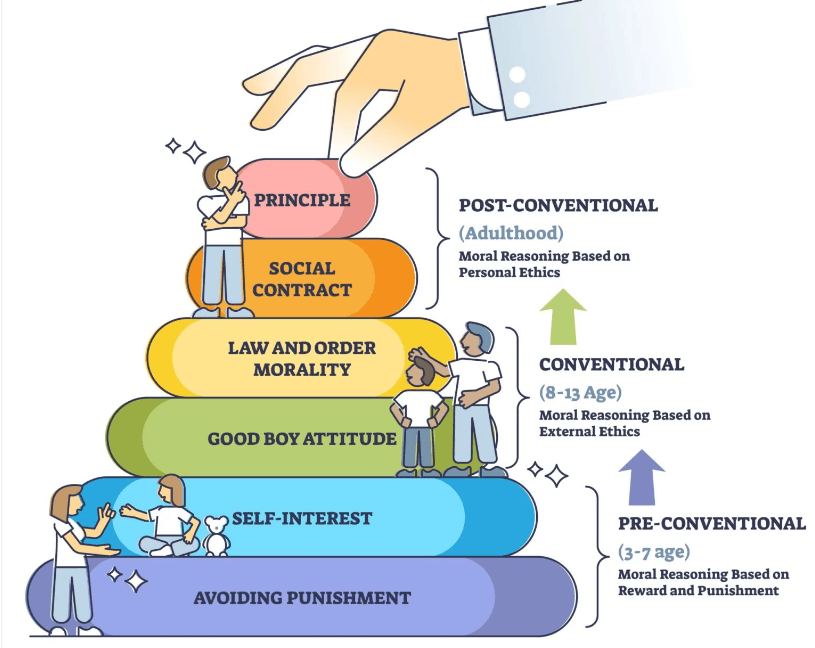
-
Preconventional Level:
- Stage 1 - Obedience and Punishment Orientation:
- Morality is based on avoiding punishment. The focus is on self-interest and the fear of consequences.
- Stage 2 - Instrumental Relativist Orientation:
- Morality is guided by personal gain. The individual considers their own needs and may make decisions based on reciprocity or fair exchange.
- Stage 1 - Obedience and Punishment Orientation:
-
Conventional Level:
-
Stage 3 - Interpersonal Concordance Orientation:
- Morality is guided by social norms and the desire for approval from others. The individual seeks to maintain positive relationships and conform to societal expectations.
-
Stage 4 - Law and Order Orientation:
- Morality is based on following rules and maintaining social order. The individual adheres to laws and obligations, valuing authority and maintaining social harmony.
-
-
Postconventional Level:
-
Stage 5 - Social Contract Orientation:
- Morality is based on social contracts and mutual agreements. The individual recognizes the importance of individual rights and the need for democratic decision-making.
-
Stage 6 - Universal Ethical Principle Orientation:
- Morality is guided by universal ethical principles and conscience. The individual follows self-chosen ethical principles and acts according to a sense of justice, equality, and respect for human dignity.
-
Mention the need for businesses to act ethically.
- Reputation and Trust:
- Ethical behavior builds a positive reputation and fosters trust among stakeholders.
- Customer Loyalty:
- Modern consumers prefer businesses with aligned ethical values, fostering customer loyalty.
- Employee Morale and Productivity:
- Ethical workplaces create a positive environment, boosting employee morale and productivity.
- Legal and Regulatory Compliance:
- Ethical practices align with legal requirements, reducing the risk of legal challenges.
- Investor Confidence:
- Ethical behavior instills confidence among investors, attracting investment.
- Sustainability and Long-Term Success:
- Ethical decision-making considers long-term impacts, contributing to sustainability.
- Competitive Advantage:
- Ethical behavior differentiates businesses and provides a competitive edge.
- Social Responsibility:
- Ethical businesses contribute positively to society, fulfilling a broader responsibility.
- Global Reputation:
- Maintaining ethical standards prevents negative publicity and enhances global reputation.
- Risk Management:
- Ethical decision-making is a proactive approach to risk management, preventing crises.
Explain five qualities of successful professional.
1. Integrity:
- Integrity is the quality of being honest, ethical, and maintaining strong moral principles.
- Professionals with integrity build trust with colleagues, clients, and stakeholders. It forms the foundation for ethical decision-making and a positive reputation.
2. Adaptability:
- Adaptability refers to the ability to adjust and thrive in changing work environments or situations.
- Successful professionals can navigate uncertainties, embrace change, and quickly adapt to new technologies, processes, or responsibilities.
3. Effective Communication:
- Effective communication involves conveying ideas, information, and feedback clearly and concisely.
- Professionals who communicate well foster strong teamwork, prevent misunderstandings, and ensure that information is conveyed accurately.
4. Leadership Skills:
- Leadership skills include the ability to inspire, motivate, and guide a team toward common goals.
- Successful professionals often exhibit leadership qualities, whether in formal leadership roles or by taking initiative and influencing positive change within the organization.
5. Continuous Learning and Adaptation:
- The willingness to learn and adapt to new knowledge, skills, and industry trends.
- In rapidly evolving work environments, professionals who prioritize continuous learning stay relevant, contribute to innovation, and enhance their career growth.
Swami Vivekananda’s thoughts on ethics are essentially practical and based on normative ethics. Discuss.
Swami Vivekananda's thoughts on ethics indeed have a practical orientation, and they are rooted in normative ethics, which deals with the standards for right and wrong behavior. Here are key aspects that highlight the practical and normative nature of Vivekananda's ethical philosophy:
Write a brief note on the ethics and moral values of Swami Vivekananda. (Summer)
Swami Vivekananda, a spiritual luminary and philosopher, placed significant emphasis on ethics and moral values as integral components of human life. His teachings, rooted in Vedanta philosophy, reflect a practical and universal approach to ethical conduct. Here's a brief overview of the ethics and moral values espoused by Swami Vivekananda:
Short note on Ethics of Swami Vivekananda.
Explain the ethics of shri Swami Vivekananda.( summer-4 )
Swami Vivekananda, a key figure in India's spiritual and philosophical landscape, advocated a robust ethical framework. His ethics can be summarized as follows:
- Duty and Responsibility:
- Swami Vivekananda emphasizes doing one's duty and fulfilling responsibilities in harmony with moral and cosmic order (dharma).
- Service to Others:
- He encourages selfless service (seva) to uplift society, viewing the well-being of others as a spiritual practice.
- Unity and Oneness:
- Vivekananda teaches about oneness and how all beings are interconnected, promoting harmony and unity.
- Equality in Spirituality:
- He embraces the idea that all individuals are spiritually equal, regardless of caste, creed, or gender.
- Wisdom and Making Right Choices:
- Vivekananda encourages developing discerning wisdom (viveka) to make ethical and righteous choices.
- Non-Violence:
- He advocates for non-violence (ahimsa) in thoughts, words, and actions as a fundamental ethical principle.
- Self-Realization and Freedom:
- The focus is on achieving self-realization and spiritual freedom (moksha) as life's ultimate goals.
- Brotherhood Beyond Boundaries:
- He spreads the idea of universal brotherhood, fostering love, compassion, and understanding among people.
- Character Education:
- Vivekananda underscores the importance of education for building strong moral and ethical character.
- Yoga for Self-Discipline:
- He teaches Raja Yoga for self-discipline and self-control, essential for ethical living.
Short note on Ethics of Mahatma Gandhi.
Mahatma Gandhi, the leader of India's nonviolent independence movement, was deeply rooted in ethical principles that shaped his philosophy of life. Here's a brief note on the ethics of Mahatma Gandhi:
- Ahinsa (Nonviolence):
- Gandhi's core principle, advocating the rejection of physical or psychological harm and promoting conflict resolution through peaceful means.
- Satyagraha (Truth-Force):
- Gandhi's concept emphasizing the transformative power of truth and the pursuit of justice through nonviolent resistance.
- Sarvodaya (Welfare for All):
- Gandhi's vision for the well-being of all, emphasizing social justice and the upliftment of the masses.
- Swadeshi (Self-Reliance):
- Gandhi's call for economic independence, promoting local industries to empower communities and reduce dependence on foreign goods.
- Simple Living and High Thinking:
- Gandhi's lifestyle philosophy, advocating simplicity and minimalism while prioritizing spiritual and intellectual growth over material pursuits.
- Integrity and Transparency:
- Gandhi's emphasis on personal integrity, aligning actions with moral principles, and promoting transparency in personal and public life.
- Religious Tolerance:
- Gandhi's advocacy for religious tolerance, respecting all faiths and envisioning a harmonious coexistence of individuals from different religions.
- Decentralization of Power:
- Gandhi's call for the distribution of political and economic power, empowering local communities and bringing decision-making closer to the people.
- Constructive Program:
- Gandhi's approach of undertaking practical, positive actions for social upliftment, addressing issues like poverty, untouchability, and illiteracy.
- Self-Discipline and Self-Realization:
- Gandhi's emphasis on personal growth through self-discipline and self-realization, encouraging individuals to contribute meaningfully to society.
Short note on Ethics of Sri Aurobindo Ghose.
Sri Aurobindo Ghose, a philosopher, poet, and spiritual leader, developed a comprehensive ethical philosophy grounded in his spiritual teachings. Here's a brief note on the ethics of Sri Aurobindo Ghose: Sri Aurobindo Ghose, an influential philosopher and spiritual leader, developed a unique ethical framework rooted in his spiritual teachings. Here's a concise overview of the ethics of Sri Aurobindo Ghose:
- Integral Yoga:
- Aurobindo's ethics were closely tied to his philosophy of Integral Yoga, aiming for the evolution of the individual and society towards a higher spiritual consciousness.
- Divine Consciousness:
- He emphasized the pursuit of a divine consciousness as the foundation of ethical living, transcending ordinary moral standards.
- Transformation of Nature:
- Aurobindo believed in the transformation of human nature, advocating for the alignment of individual desires with the divine will for a harmonious existence.
- Unity of Existence:
- His ethics were centered on the understanding of the unity of all existence, fostering a sense of oneness and interconnectedness.
- Evolutionary Ethics:
- Aurobindo's ethics focused on the evolutionary progress of the soul, guiding individuals towards a higher ethical and spiritual plane.
- Synthesis of Yoga:
- The synthesis of various yogic paths, including knowledge, devotion, and selfless action, formed the basis of his ethical teachings.
- Service to Humanity:
- Aurobindo emphasized selfless service to humanity as a means to express spiritual values and contribute to the collective evolution.
- Transcendence of Ego:
- His ethical teachings encouraged the transcendence of ego-driven desires and the realization of a higher self, promoting humility and selflessness.
Short note on Ethics of Rabindranath Tagore.
Rabindranath Tagore, the renowned Indian poet, philosopher, and Nobel laureate, expressed his ethical philosophy through his writings and actions. Here's a brief note on the ethics of Rabindranath Tagore:
- Love for Humanity:
- Tagore believed that finding the supreme reality involves loving and understanding each other.
- Freedom for Everyone:
- He thought that everyone deserves spiritual, economic, and political freedom. The government should work for people's well-being.
- Stand Up for Rights:
- Tagore encouraged fearlessness and standing up for what is right. He valued justice for every individual.
- Cultural Revival:
- He wanted to bring back ancient Indian culture, emphasizing social unity alongside political institutions.
- Revolutionary Education:
- Tagore's idea of education was about overall development, joy, and freedom. No harsh punishments or unnecessary exams.
- Blend of Cultures:
- He envisioned education that blends Eastern and Western cultures, connecting India with the world.
- Spiritual Growth:
- Tagore believed that spiritual practice leads to self-purity and realizing our best selves.
- Doing Good for Others:
- Like other thinkers, he highlighted the importance of doing good for others as the ultimate good.
Presume that pawan is a senior officer working for cyber security agency. He comes to know that his junior officer has been a victim of honey trapping through social media. In all of this, his phone was hacked and confidential files were leaked. The entire department has come together and wants pawan to take strict actions against junior officer for his behavior. That junior officer is highly skilled and is an asset to organization. He is also close to pawan as he had mentored him throughout and respects him a lot. Moreover, any action against him might attract media attention and bring a bad repute to the entire organization at large. i. What are the ethical issues involved and options available to pawan in such a situation? ii. Suggest a course of action that pawan would take to resolve it.
Ethical Issues:
-
Security Breach: Breach of confidentiality due to the junior officer's actions.
-
Professional Responsibility: Pawan's responsibility as a senior officer to address the breach and maintain departmental integrity.
-
Personal Relationship: Pawan's close mentoring relationship with the junior officer influences objectivity in taking action.
Options Available to Pawan:
-
Strict Disciplinary Action: Enforce strict disciplinary measures against the junior officer to uphold departmental standards and accountability.
-
Mitigation and Counseling: Offer guidance and counseling to the junior officer, addressing the breach while preserving his position within the organization.
-
Protection of Skilled Asset: Consider alternative consequences rather than severe punishment to retain the skilled officer.
Recommended Course of Action for Pawan: Pawan should consider a balanced approach:
-
Investigation: Conduct a thorough investigation into the security breach and the extent of the officer's involvement without bias.
-
Confidential Resolution: Handle the matter internally to prevent media attention, safeguarding the organization's reputation.
-
Education and Corrective Action: Provide education on cybersecurity ethics and impose corrective measures, emphasizing the seriousness of the breach.
-
Support and Mentorship: Continue offering support and mentorship to the junior officer, reinforcing ethical standards and guiding him towards rectifying his mistake.
-
Professional Accountability: Ensure accountability while balancing professional responsibility and personal relationships, taking measures that uphold integrity without ruining the officer's career.
Mention the business ethics in Islam keeping into context the indian ethical traditions.
Business Ethics in Islam:
- Integrity and Honesty (Amanah):
- Islam values honesty and integrity, emphasizing Amanah, or trustworthiness, in business dealings.
- Fair Trade and Justice (Adl):
- Islamic business ethics stress fairness (Adl) to ensure just transactions and avoid exploitation.
- Avoidance of Riba (Usury/Interest):
- Islam prohibits interest (riba) to promote economic justice and prevent exploitation.
- Ethical Investment (Halal and Tayyib):
- Businesses and investments in Islam should be Halal (permissible) and Tayyib (pure), avoiding harmful activities.
- Social Responsibility (Takaful):
- Islamic businesses are encouraged to practice Takaful, contributing to the welfare of the community.
- Respect for Contracts (Mithaq):
- Contracts (Mithaq) are considered sacred in Islam, and businesses are expected to honor agreements.
- Ethical Marketing and Transparency (Al-Shuhra):
- Islamic business ethics emphasize transparent marketing (Al-Shuhra) and discourage deceptive practices.
Contextualizing Indian Ethical Traditions:
- Dharma and Righteous Conduct:
- Indian traditions emphasize Dharma, aligning with Islamic values of righteous conduct in business.
- Ahimsa (Non-violence) and Compassion:
- Both traditions promote non-violence (Ahimsa) and compassion, discouraging exploitation.
- Sarvodaya (Welfare for All):
- The concept of Sarvodaya in Indian traditions resonates with Islamic principles of social responsibility.
- Dana (Charity) and Zakat:
- Indian Dana (charity) aligns with Islam's practice of Zakat, emphasizing philanthropy and social welfare.
- Satya (Truthfulness) and Amanah:
- The emphasis on Satya (truthfulness) in Indian traditions aligns with Islam's Amanah, promoting honesty.
Describe Lessons from Ancient Indian Education system. ( 4 winter )
Discuss at least seven notable features of ancient Indian education system.
Seven Notable Features of Ancient Indian Education System:
- Gurukula System:
- Ancient Indian education was structured around the Gurukula system, a residential arrangement where students lived with their guru. This close teacher-student bond aimed at not just academic education but also character development.
- Holistic Education:
- The system emphasized holistic development, covering physical, mental, and moral aspects. Beyond academics, students received training in arts, music, philosophy, ethics, and physical fitness for a well-rounded education.
- Oral Tradition:
- Knowledge was transmitted orally, preserving the purity of teachings. This oral tradition ensured accurate dissemination of sacred texts, philosophical insights, and scientific knowledge.
- Varied Subjects and Specializations:
- Ancient Indian education offered a diverse range of subjects like Vedas, Upanishads, mathematics, astronomy, and medicine. Students could specialize in their preferred field, encouraging expertise.
- Spiritual and Moral Emphasis:
- Moral and spiritual education was integral, focusing on ethical teachings and virtues. The aim was not just intellectual knowledge but also the cultivation of values for a purposeful life.
- Student-Centric Learning:
- Recognizing individuality, teachers tailored education to each student's style and pace. This personalized approach aimed at maximizing the potential of every learner.
- Practical and Experiential Learning:
- The system emphasized hands-on learning through discussions, debates, experiments, and real-world applications. This practical approach deepened understanding and connected theory with real-life scenarios.
Briefly describe three two laws of karma by providing appropriate examples.
The laws of karma, a fundamental concept in Hinduism, Buddhism, and Jainism, outline the cause-and-effect relationship based on one's actions. Here are two key laws of karma along with examples:
- Law of Cause and Effect:
- Description: This law posits that every action has consequences, and the nature of the consequences is determined by the quality and intention behind the action.
- Example: If a person helps others selflessly and with genuine compassion (positive action), the consequences may include a sense of fulfillment, positive energy, and goodwill in their relationships. Conversely, if someone engages in harmful actions with ill intent, the consequences may involve negative repercussions, strained relationships, and a sense of guilt or remorse.
- Law of Karma and Reincarnation:
- Description: This law suggests that the consequences of one's actions extend beyond the current lifetime, influencing future experiences. The soul undergoes a cycle of birth and rebirth (reincarnation), and the accumulated karma shapes the circumstances of each successive life.
- Example: If an individual consistently engages in acts of kindness, generosity, and moral conduct in their current life, it is believed that they may be reborn into more favorable circumstances in their next life. Conversely, if someone engages in harmful actions and accumulates negative karma, they may face challenges or unfavorable conditions in subsequent lives.
Neelam is working as senior HR manager at Zion IT company. Mention the code of personal ethics she needs to possess as an employee of the organization.
- Confidentiality:
- Description: Maintain the confidentiality of employee information, sharing details only on a need-to-know basis.
- Integrity:
- Description: Act with honesty and uphold a high standard of ethical conduct in all professional dealings.
- Fairness and Equity:
- Ensure fair and equitable HR practices, treating all employees with respect regardless of background or status.
- Compliance with Laws and Policies:
- Ensure HR practices comply with local laws and company policies to maintain legal and ethical standards.
- Professional Development:
- Engage in continuous professional development to stay informed about industry trends and best practices.
- Conflict Resolution:
- Address workplace conflicts impartially, fostering open communication and seeking fair resolutions.
- Diversity and Inclusion:
- Promote diversity and inclusion by providing equal opportunities and fostering a respectful workplace culture.
- Employee Well-being:
- Prioritize the well-being of employees by implementing policies that support a healthy work-life balance.
- Professionalism:
- Demonstrate professionalism in all interactions, maintaining a positive attitude and reliability.
- Conflict of Interest:
- Avoid situations where personal interests conflict with the company's, disclosing and mitigating potential conflicts.
Define white-collar crime (WCC). Enlist few of the most white- collar offenses observed in recent times. Mention the ### penalties for WCC’s.
White-Collar Crime (WCC) Definition: White-collar crime refers to non-violent, financially motivated offenses typically committed by individuals, businesses, or government professionals in positions of trust and authority. These crimes are characterized by deceit, concealment, or violation of trust, often committed for financial gain.
Few White-Collar Offenses Observed in Recent Times:
- Corporate Fraud:
- Manipulation of financial statements, embezzlement, or insider trading within corporations.
- Cybercrime:
- Hacking, identity theft, or electronic fraud targeting individuals, businesses, or financial institutions.
- Securities Fraud:
- Deceptive practices in the stock or commodities markets, including misinformation to investors.
- Tax Evasion:
- Illegally reducing tax liability by misrepresenting or concealing income.
- Environmental Crimes:
- Violations of environmental laws and regulations for financial gain, such as illegal disposal of hazardous waste.
Penalties for WCCs:
Penalties for white-collar crimes can vary based on the specific offense and jurisdiction. Common penalties may include:
-
Fines: Monetary penalties imposed on individuals or corporations found guilty of white-collar offenses.
-
Restitution: Repayment of financial losses to victims resulting from the criminal activity.
-
Probation: Supervised release instead of imprisonment, often with specific conditions.
-
Imprisonment: Jail or prison sentences, with durations depending on the severity of the offense.
-
Forfeiture: Confiscation of assets acquired through the criminal activity.
Briefly describe the ethical models that guides decision making.
- Consequentialism:
- Focuses on the outcomes of actions.
- Chooses actions for the greatest overall good or least harm.
- Deontology:
- Emphasizes moral rules or duties.
- Decides based on the inherent rightness or wrongness of actions.
- Virtue Ethics:
- Cultivates virtuous character traits.
- Decides by considering what a virtuous person would do.
- Rights-Based Ethics:
- Respects and protects individual rights.
- Prioritizes decisions upholding those rights.
- Utilitarianism:
- Aims to maximize overall happiness.
- Decides based on the greatest happiness for the greatest number.
- Ethical Relativism:
- Acknowledges varying ethical principles.
- Decides considering cultural or contextual norms.
- Social Contract Theory:
- Focuses on agreed-upon principles in a social contract.
- Promotes cooperation and fairness.
- Casuistry:
- Involves case-based reasoning.
- Analyzes similarities with past cases for ethical solutions.
What is the role of Manager in business? List and explain values of Indian Manager.
Managerial Roles and Functions:
- Planning:
- Engage in strategic planning to establish organizational goals and prioritize actions.
- Organizing:
- Optimize efficiency by organizing resources, tasks, and people to achieve objectives.
- Leading:
- Provide leadership through effective communication, collaboration, and employee development.
- Decision-making:
- Analyze information, evaluate options, and make informed decisions aligned with organizational goals.
- Controlling:
- Monitor progress, measure performance, and address deviations to ensure standards are met.
Values of Indian Managers:
- Respect for Hierarchy:
- Emphasize respect for authority and adhere to hierarchical structures.
- Team Orientation:
- Prioritize teamwork, fostering unity, and promoting collective achievements over individual accomplishments.
- Long-term Perspective:
- Prioritize sustainability, stability, and building enduring relationships for long-term success.
- Ethical Conduct:
- Prioritize integrity, fairness, and transparency in business practices.
- Relationship Building:
- Emphasize building strong interpersonal relationships and creating a supportive work environment.
What do you mean by Quality of Working life? List and explain affecting factors of on working life.
Quality of working life (QWL) refers to the overall well-being and satisfaction that individuals experience in their work environment. It encompasses various aspects of work that influence an individual’s physical, psychological, and social well-being. Here are some factors that can affect the quality of working life:
- Job Design:
- Meaningful tasks, autonomy, skill utilization, and feedback impact job satisfaction and motivation.
- Work-Life Balance:
- Balancing work and personal life through flexible arrangements and sufficient time off enhances well-being.
- Work Environment:
- Safety, comfort, cleanliness, and supportive relationships contribute to a positive workplace culture.
- Compensation and Benefits:
- Fair and competitive rewards, along with attractive benefits, drive satisfaction and motivation.
- Career Development and Growth:
- Opportunities for advancement, learning, and skill development positively impact well-being.
- Workload and Stress:
- Managing workload, realistic deadlines, and stress support a healthy work environment.
- Recognition and Feedback:
- Appreciating contributions and providing feedback positively influence job satisfaction and motivation.
- Organizational Culture and Leadership:
- Supportive, transparent, and ethical leadership fosters trust and a positive work environment.
Explain the importance of quality of working life in profession. (Summer)
- Employee Well-being:
- QWL prioritizes the physical, mental, and emotional well-being of employees, creating a healthier work environment.
- Job Satisfaction and Motivation:
- QWL contributes to job satisfaction, motivating employees and increasing overall productivity.
- Retention of Talent:
- Organizations focusing on QWL are more likely to retain top talent, reducing turnover costs.
- Work-Life Balance:
- QWL initiatives support a healthy work-life balance, fostering long-term commitment from employees.
- Increased Productivity:
- QWL addresses factors hindering productivity, creating an environment conducive to efficient work.
- Enhanced Organizational Reputation:
- Organizations known for promoting QWL are perceived positively, attracting top talent and customers.
- Innovation and Creativity:
- QWL fosters a culture of collaboration and openness, encouraging innovation among employees.
- Health and Safety:
- QWL includes measures for a safe and healthy workplace, protecting employees and promoting a positive atmosphere.
- Employee Engagement:
- QWL initiatives engage employees by involving them in decision-making processes, leading to higher job satisfaction.
Discuss the sources of ethical behavior (3)
List and Explain sources of Ethical Behavior.
Ethical behavior is influenced by various sources that shape an individual’s moral values, beliefs, and actions. Here are some common sources of ethical behavior:
- Personal Values:
- Internal guiding beliefs shaped by upbringing, culture, religion, experiences, and education.
- Moral Development:
- Process of acquiring ethical principles influenced by upbringing, education, social interactions, and experiences.
- Cultural Norms and Practices:
- Shapes ethical behavior through unique values, customs, and traditions within a culture.
- Legal Framework:
- Establishes laws and regulations as a baseline for ethical standards, reflecting societal judgments.
- Organizational Culture:
- Strongly influences ethical behavior by fostering integrity, promoting values, and creating a supportive climate.
- Role Models and Leaders:
- Leaders and respected figures significantly shape and influence ethical conduct through example.
- Social Influence and Peer Pressure:
- Impact on ethical behavior through social circles, peer attitudes, and pressures to conform.
Explain Ethical Decision Making. Explain Six-step decision making model.
Ethical decision making refers to the process of evaluating and selecting the most morally sound course of action when faced with ethical dilemmas or complex situations. It involves considering ethical principles, values, and potential consequences to make informed and ethical choices. Here is a commonly used six-step ethical decision-making model:
- Identify the Problem:
- Clearly define the ethical dilemma, understanding key facts, parties involved, and conflicting values.
- Gather Information:
- Collect relevant information, seek perspectives, consult laws, and research potential consequences.
- Identify Ethical Principles:
- Consider relevant ethical principles (e.g., honesty, fairness) and determine their guidance.
- Generate Options:
- Brainstorm various courses of action, exploring potential consequences and implications.
- Evaluate Options:
- Weigh pros and cons of each option against ethical principles and values, considering short-term and long-term impacts.
- Make a Decision and Take Action:
- Select the most ethical option, implement it with integrity, transparency, and accountability, and communicate the rationale.
Mention principles of professional ethics.(winter 4)
Mention principles of personal ethics.(winter 4)
Explain Principles of Personal Ethics.(winter 4)
Explain the principles of Personal ethics and Professional ethics?
- Personal ethics and professional ethics are two dimensions of ethical behavior that guide individuals in their personal lives and professional careers.
- Here's an explanation of each:
Personal Ethics:
1. Integrity:
- Upholding a strong sense of honesty and truthfulness in personal actions.
- Adhering to one's moral principles even in challenging situations.
2. Responsibility:
- Taking ownership of one's decisions and actions.
- Being accountable for the consequences of personal choices.
3. Respect for Others:
- Valuing and treating others with dignity, empathy, and consideration.
- Acknowledging and appreciating diverse perspectives.
4. Fairness:
- Striving for fairness and justice in personal interactions.
- Avoiding favoritism and treating everyone equitably.
5. Compassion:
- Demonstrating kindness and empathy towards others.
- Being aware of and responsive to the needs and feelings of others.
6. Self-Discipline:
- Exercising self-control and discipline in personal behavior.
- Resisting impulsive or unethical actions.
Professional Ethics:
1. Honesty and Transparency:
- Communicating truthfully and openly in professional settings.
- Avoiding deception or misleading information.
2. Integrity in Business Transactions:
- Upholding ethical standards in business dealings.
- Refraining from bribery, corruption, or fraudulent activities.
3. Confidentiality:
- Respecting and maintaining the confidentiality of sensitive information.
- Safeguarding proprietary and client-related data.
4. Conflict of Interest:
- Identifying and managing conflicts of interest appropriately.
- Prioritizing the interests of the organization and its stakeholders.
5. Professional Competence:
- Striving for continuous improvement and professional development.
- Maintaining and updating skills to provide high-quality services.
6. Social Responsibility:
- Contributing to the well-being of society and the environment.
- Balancing profit motives with ethical considerations.
7. Legal Compliance:
- Adhering to applicable laws and regulations.
- Ensuring that professional practices align with legal standards.
Explain concept of Ethical dilemmas.(winter 3)
What is Ethical Dilemmas? Explain with example.(4 winter)
What is an ethical dilemma? Give a suitable example. Suggest a viable approach to resolve the same. (summer-4)
What is an Ethical Dilemma? How to Resolve Ethical Dilemmas.
Ethical Dilemma:
- An ethical dilemma is a situation in which a person faces conflicting moral principles, making it challenging to determine the right course of action.
- It involves a choice between two or more morally acceptable options, where each option may have positive and negative consequences.
- Ethical dilemmas often arise when individuals encounter situations where values, duties, or obligations are in conflict.
Characteristics of Ethical Dilemmas:
-
Conflicting Principles: Ethical dilemmas involve a clash between fundamental moral principles or values.
-
No Clear Solution: There is no obvious or straightforward solution that satisfies all moral considerations.
-
Complexity: Ethical dilemmas are often complex and involve multiple factors that need careful consideration.
-
Consequences: Each potential decision has consequences, and individuals must weigh the ethical implications of their choices.
Resolving Ethical Dilemmas: The process for resolving ethical dilemmas involves considering different ethical approaches and steps to guide decision-making. Here's an overview:
Ethical Approaches:
1. Deontological (Action-Oriented) Approach:
- Based on ethical standards consistent with actions performed by rational and free individuals.
- Involves inalienable rights inherent to human beings, reflecting defining features of human nature.
- Fundamental moral rights are considered universally recognized.
2. Teleological (Results-Oriented) Ethics:
- Focuses on the moral character of actions based on the outcomes and how they help or harm people.
- Considers actions that produce more benefits than harms as "right" and those that don't as "wrong."
- A three-step strategy involves analyzing consequences, actions, and making a decision.
Steps in Resolving Ethical Dilemmas:
1. Determine Ethical Issue or Dilemma:
- Identify conflicts of values, rights, or professional responsibilities.
2. Identify Key Values and Principles:
- Understand meanings and limitations associated with competing values.
3. Rank Values or Ethical Principles:
- Prioritize competing values or principles based on professional judgment.
- Provide reasons for prioritization.
4. Develop an Action Plan:
- Create a plan consistent with ethical priorities identified as central to the dilemma.
5. Implement the Plan:
- Apply the action plan using appropriate skills and competencies.
6. Reflect on the Outcome:
- Evaluate the outcome of the ethical decision-making process.
- Reflect on the effectiveness of the chosen course of action.
Explain Roots of unethical Behavior.(summer-3)
List and explain the roots of unethical behavior.
- Lack of Moral Education:
- Insufficient upbringing in moral values and ethical principles can contribute to unethical conduct.
- Financial Pressures:
- Economic challenges or financial strain may drive individuals to compromise ethical standards for personal gain.
- Lack of Oversight:
- Inadequate supervision or organizational oversight may create an environment conducive to unethical behavior.
- Cultural Norms:
- Societal norms that tolerate or normalize unethical practices can influence individual behavior.
- Pressure to Succeed:
- Intense competition or performance pressures may lead individuals to engage in unethical actions to achieve success.
- Lack of Accountability:
- Absence of clear consequences for unethical conduct may foster a culture where individuals feel immune to repercussions.
- Organizational Culture:
- A workplace culture that prioritizes results over ethical behavior may contribute to misconduct.
- Poor Leadership Examples:
- Leadership that lacks ethical integrity can set a precedent for unethical behavior within an organization.
- Fear of Retaliation:
- Concerns about retaliation or negative consequences for whistleblowing may deter individuals from reporting unethical behavior.
- Social Influence:
- Peer pressure or the influence of colleagues can lead individuals to engage in unethical actions.
- Lack of Empathy:
- Insufficient empathy or understanding of the impact of one's actions on others can contribute to unethical behavior.
- Personal Rationalization:
- Individuals may rationalize unethical actions by convincing themselves that the ends justify the means.
Enlist roots of unethical behavior and the factors that contribute the employees to think in an unethical manner. (4 winter)
Discuss the causes of unethical behavior in private business.
- Unethical behavior in private businesses can stem from various factors and influences within the organizational environment.
- Understanding the causes of unethical behavior is crucial for developing strategies to promote ethical conduct.
- Here are some common causes:
- Pressure to Achieve Targets:
- Employees and managers may face intense pressure to meet performance targets, sales quotas, or financial goals. This pressure can lead individuals to compromise ethical standards to achieve short-term success.
- Lack of Ethical Leadership:
- Leadership plays a significant role in setting the ethical tone of an organization. If leaders prioritize results over ethical behavior or engage in unethical practices themselves, it sets a precedent for others to follow suit.
- Weak Organizational Culture:
- An organizational culture that does not prioritize ethics and integrity can contribute to unethical behavior. When values and expectations are unclear or inconsistent, employees may lack guidance on ethical decision-making.
- Lack of Accountability:
- In environments where there is a lack of accountability for unethical actions, individuals may feel they can act with impunity. If there are no consequences for unethical behavior, it may become more prevalent.
- Inadequate Training and Awareness:
- Employees may engage in unethical behavior if they are not adequately trained on ethical guidelines or are unaware of the potential consequences of their actions. Education on ethical conduct is essential for fostering a culture of integrity.
- Poorly Defined Policies:
- Organizations with vague or poorly defined ethical policies may leave employees uncertain about what is considered acceptable behavior. Clear and well-communicated policies help guide ethical decision-making.
- Individual Characteristics:
- Certain personality traits or characteristics of individuals, such as a lack of empathy, a focus on self-interest, or a propensity for risk-taking, can contribute to unethical behavior.
- Competitive Pressures:
- In highly competitive industries, the desire to gain a competitive edge can lead individuals and organizations to engage in unethical practices, such as corporate espionage, bribery, or spreading false information about competitors.
- Lack of Whistleblower Protection:
- Without adequate protection for whistleblowers, individuals may fear retaliation for reporting unethical behavior. This fear can prevent the exposure of wrongdoing within the organization.
- Short-Term Focus:
- A focus on short-term profits or immediate results without considering the long-term consequences can lead to unethical decision-making. Organizations that prioritize long-term sustainability are more likely to act ethically.
- Groupthink and Conformity:
- Group dynamics can influence individual behavior. In environments where groupthink prevails, individuals may conform to unethical actions to align with the group's consensus.
What are the sources of ethical problems in business? How can these be solved?
Sources of ethical problems in business often arise from various factors, and addressing them requires a multi-faceted approach. Here are some common sources and potential solutions:
Sources of Ethical Problems:
-
Lack of Ethical Leadership:
- Issue: When leaders fail to model ethical behavior, it sets a poor example for employees.
- Solution: Promote ethical leadership through training, mentorship, and holding leaders accountable for their actions.
-
Pressure for Short-Term Results:
- Issue: The pursuit of immediate gains can lead to unethical decisions.
- Solution: Encourage a long-term perspective, aligning goals with sustainable practices and ethical conduct.
-
Conflict of Interest:
- Issue: Personal interests conflicting with organizational goals can lead to biased decision-making.
- Solution: Establish clear policies, disclose potential conflicts, and implement mechanisms for resolution.
-
Lack of Transparency:
- Issue: Withholding information or lack of transparency can breed mistrust.
- Solution: Promote open communication, disclose relevant information, and foster a culture of transparency.
-
Unfair Treatment and Discrimination:
- Issue: Discrimination in hiring, promotions, or daily interactions creates ethical concerns.
- Solution: Implement diversity and inclusion initiatives, provide sensitivity training, and enforce anti-discrimination policies.
-
Pressure to Cut Corners:
- Issue: Tight deadlines or financial constraints may lead to compromising ethical standards.
- Solution: Emphasize the importance of ethics, provide adequate resources, and encourage reporting of unethical practices.
-
Inadequate Ethical Training:
- Issue: Employees may not be aware of ethical standards or the consequences of unethical behavior.
- Solution: Conduct regular ethics training, workshops, and awareness programs to educate employees on ethical guidelines.
-
Globalization Challenges:
- Issue: Operating in different cultural contexts may lead to ethical dilemmas.
- Solution: Develop a global code of ethics, understand cultural nuances, and ensure compliance with local regulations.
Discuss the importance of morality and laws in context of business.
Importance of Morality in Business:
-
Ethical Decision-Making:
- Significance: Morality guides individuals in making decisions aligned with principles of right and wrong.
- Impact on Business: Fosters ethical decision-making, leading to responsible and sustainable business practices.
-
Building Trust and Reputation:
- Significance: Moral conduct builds trust among stakeholders.
- Impact on Business: Establishes a positive reputation, enhancing customer loyalty and attracting ethical partners.
-
Employee Engagement and Satisfaction:
- Significance: Moral leadership and ethical practices contribute to a positive work environment.
- Impact on Business: Engaged and satisfied employees lead to increased productivity, reduced turnover, and a positive corporate culture.
-
Long-Term Success:
- Significance: Ethical behavior contributes to long-term business success.
- Impact on Business: Builds resilience, mitigates risks, and fosters sustainable growth over time.
-
Social Responsibility:
- Significance: Moral considerations extend beyond profit-making to include social responsibility.
- Impact on Business: Positive social impact enhances brand image and contributes to the overall well-being of communities.
Importance of Laws in Business:
-
Legal Compliance:
- Significance: Laws provide a framework for businesses to operate within legal boundaries.
- Impact on Business: Compliance prevents legal issues, fines, and reputational damage associated with violating regulations.
-
Protection of Stakeholder Rights:
- Significance: Laws protect the rights of stakeholders, including customers, employees, and investors.
- Impact on Business: Fosters trust and accountability, contributing to a healthy and transparent business environment.
-
Dispute Resolution:
- Significance: Legal systems offer mechanisms for resolving disputes and conflicts.
- Impact on Business: Facilitates fair and just resolution, avoiding costly and time-consuming legal battles.
-
Consumer Protection:
- Significance: Laws safeguard consumers from unfair business practices.
- Impact on Business: Builds consumer confidence, protects brand reputation, and ensures fair competition.
-
Environmental Protection:
- Significance: Environmental laws regulate business activities to minimize ecological impact.
- Impact on Business: Promotes sustainability, reduces environmental risks, and aligns with societal expectations.
-
Market Stability:
- Significance: Laws contribute to market stability by preventing fraudulent practices and ensuring fair competition.
- Impact on Business: Fosters a level playing field, supporting healthy market dynamics and business growth.
-
Contractual Relationships:
- Significance: Legal frameworks govern contractual agreements between parties.
- Impact on Business: Ensures enforceability of contracts, clarity in business transactions, and resolution mechanisms for breaches.
Why should businesses act ethically? Discuss one example where acting unethically harmed the business and its stake holders.
Why Businesses Should Act Ethically:
-
Reputation Boost:
- Importance: Ethical behavior enhances a company's reputation.
- Impact: A good reputation attracts more customers and positive attention.
-
Customer Trust:
- Importance: Ethical practices build trust with customers.
- Impact: Trustworthy businesses gain customer loyalty and repeat business.
-
Happy Employees:
- Importance: Ethical workplaces lead to satisfied employees.
- Impact: Happy employees are more productive and contribute to a positive work environment.
-
Avoid Legal Issues:
- Importance: Ethical practices ensure legal compliance.
- Impact: Avoiding legal problems helps businesses run smoothly and saves money.
-
Investor Appeal:
- Importance: Ethical behavior attracts ethical investors.
- Impact: Investors are more likely to support businesses with a clean ethical track record.
Example of Unethical Behavior Harming a Business:
Social Media Deception:
- Unethical Actions: A company creates fake social media reviews to boost its online image.
- Harm to Business and Stakeholders:
- Loss of Trust: Customers discover the deception, leading to a loss of trust.
- Customer Backlash: Negative online reviews and a social media backlash can harm the business.
- Reputation Damage: The company's reputation suffers, impacting sales and customer perception.
Lesson Learned: This example illustrates how an unethical action, like creating fake reviews, can harm a business by eroding customer trust and damaging its reputation. It emphasizes the importance of honesty in maintaining positive relationships with customers.
What values company expect from their employees?
Companies typically expect their employees to adhere to a set of values that align with the organization's mission, vision, and culture. These values contribute to creating a positive work environment, fostering collaboration, and promoting ethical behavior. While specific values may vary across organizations, common values that companies often expect from their employees include:
- Integrity:
- Upholding high ethical standards, honesty, and transparency in all professional interactions.
- Accountability:
- Taking responsibility for one's actions, decisions, and outcomes, and being answerable for the results.
- Teamwork and Collaboration:
- Working collaboratively with colleagues, sharing knowledge, and contributing to a positive and inclusive team culture.
- Respect:
- Treating colleagues, clients, and stakeholders with dignity, courtesy, and consideration, regardless of differences.
- Innovation:
- Embracing creativity, adaptability, and a willingness to explore new ideas and solutions to drive innovation.
- Customer Focus:
- Prioritizing customer needs and providing excellent service, understanding that customer satisfaction is crucial to the success of the business.
- Quality Excellence:
- Striving for excellence in work, delivering high-quality products or services, and maintaining a commitment to continuous improvement.
- Diversity and Inclusion:
- Embracing diversity and fostering an inclusive environment that values different perspectives, backgrounds, and experiences.
- Adaptability:
- Demonstrating flexibility and resilience in the face of change, adapting to new challenges, and remaining open to learning.
- Professionalism:
- Conducting oneself in a manner that reflects professionalism, including punctuality, effective communication, and a positive attitude.
- Innovation:
- Embracing a mindset of continuous improvement, proactively seeking ways to innovate and enhance processes, products, or services.
- Environmental and Social Responsibility:
- Recognizing the impact of business activities on the environment and society, and contributing to sustainable and socially responsible practices.
- Leadership:
- Demonstrating leadership qualities, whether in a formal managerial role or by taking initiative and inspiring others through example.
- Communication Skills:
- Effectively communicating ideas, feedback, and information with clarity and professionalism.
- Work-Life Balance:
- Recognizing the importance of maintaining a healthy work-life balance to ensure overall well-being.
Compare and contrast the Utilitarianism and Deontology ethical theories.
| Aspect | Utilitarianism | Deontology |
|---|---|---|
| Basis | The rightness or wrongness is based on the overall happiness or pleasure it brings to the greatest number of people. | The rightness or wrongness is based on adherence to a set of moral rules or duties. |
| Focus | Consequences are the primary focus. | Intentions and inherent nature of the action are crucial. |
| Principle | The principle of utility – maximizing overall happiness. | Moral rules or duties. |
| Evaluation | Actions are judged by their consequences. | Actions are judged based on adherence to moral rules, regardless of consequences. |
| Decision-Making | Outcome-oriented. | Duty-oriented. |
| Flexibility | Flexible, as actions are evaluated based on consequences. | Less flexible, as actions are evaluated based on adherence to rules. |
| Moral Agents | Focus on the overall well-being of individuals. | Focus on adherence to moral rules. |
| Example | Sacrificing one innocent person to save many others may be justified if it maximizes overall happiness. | Upholding the principle of not killing, even if it could save many lives. |
| Ethical Dilemmas | May justify actions that go against common moral intuitions in certain situations. | May provide clear guidance in adhering to moral rules, but consequences might be less predictable. |
| Criticism | Criticized for potential injustices if the majority benefits at the expense of a minority. | Criticized for potential inflexibility in situations where rules might lead to morally questionable outcomes. |
Discuss Walton’s six models of business conduct.
- All businesses must meet certain standards of law and minimum cultural standards.
- All are further influenced by the general cultural aspects of their time. But in spite of these tendencies uniform conduct, there are important differences among business.
- Each has its own personality, as each human being does.
- These organizational differences are reflected in company codes of conduct and they do produce different results.
- As a guide to understanding different types of business conduct, Walton classifies six models of conduct.
- Those are Discussed bellow:-
- The austere model:
- It gives almost exclusive emphasis to ownership interest and profit objective. In this model, a business firm exclusively emphasizes owners’ interest and the profit motive.
- The household model:
- The concept of extended family this model emphasizes employee job, benefits, and paternalism. The firm adopting this model employs a paternalistic approach with its employees.
- The vendor model:
- In this model, consumer interest, tastes, and rights dominate the organization. In this model, the interests and rights of customers are given top priority.
- The investment model:
- This model focuses on the organization as an entity and thus on long-term profits and survival. Social investment is given recognition along with economic investments.
- The civic model:
- Its slogan is corporate citizenship. It goes beyond imposed obligations, accepts. This model makes a positive commitment to social needs its slogan is corporate citizenship and social responsibility is accepted.
- The artistic model:
- This model encourages the organizations to become creative instrument serving the cause of an advanced civilization with a better quality of life. Creative ideas are generated and used for this purpose.
What are the steps in making a good ethical decision? Explain with an illustration.
Getting the facts right is very important in decision making. Provide guidelines that help in getting reliable facts.
How Human values are important for a manager? Explain in detail.
Discuss the importance of human values for Indian manager.
-
Guiding Decision-Making:
- Human values serve as guiding principles for Indian managers, influencing ethical decision-making in professional contexts.
-
Building Trust and Respect:
- Embracing values such as integrity, honesty, and respect fosters trust among team members and establishes a positive work culture.
-
Cultural Sensitivity:
- Human values, rooted in cultural understanding, enable Indian managers to navigate diverse workplaces with sensitivity and inclusivity.
-
Employee Motivation:
- Values like empathy and fairness contribute to employee satisfaction and motivation, enhancing overall organizational performance.
-
Societal Contribution:
- Indian managers, guided by values, contribute positively to societal well-being, aligning business practices with broader social responsibilities.
-
Long-Term Organizational Success:
- Integrating human values ensures sustained success by promoting ethical practices, stakeholder trust, and a resilient organizational culture.
-
Adaptability and Leadership:
- Values shape adaptive leadership, enabling Indian managers to navigate challenges with resilience and inspire teams toward collective success.
What are business ethics? Describe its nature. Is business ethics a necessity?
Business Ethics Definition:
- Business ethics refers to the application of ethical principles and values in the context of business activities, emphasizing fair and responsible conduct.
-
Nature of Business Ethics:
- Business ethics applies moral principles to business activities, guiding decisions, policies, and practices.
-
Integration of Ethical Principles:
- It integrates integrity, transparency, fairness, and social responsibility into business operations, fostering an ethical organizational culture.
-
Balancing Profit and Ethics:
- Business ethics navigates the delicate balance between profit motives and responsible, morally sound practices.
-
Social Responsibility:
- Beyond profit, it entails a commitment to social responsibility, addressing environmental concerns and contributing to community well-being.
-
Employee and Stakeholder Relations:
- Ethical practices cultivate positive relations with employees and stakeholders, promoting trust, transparency, and collaboration.
-
Long-Term Sustainability:
- Essential for sustainability, ethical conduct ensures lasting relationships, a positive reputation, and resilience in the face of challenges.
-
Necessity of Business Ethics:
- Business ethics is imperative, fostering trust, attracting talent, enhancing brand value, and ensuring organizational resilience in a dynamic business environment.
Explain personal values and ethical decision making.
Explain the impact of personal values on Ethical decision making.(summer-3)
- Influence on Priorities:
- Personal values shape individuals' priorities, affecting how they weigh different ethical considerations.
- Moral Compass:
- Values act as a moral compass, guiding individuals in aligning their decisions with deeply held beliefs.
- Conflict Resolution:
- Personal values assist in resolving ethical dilemmas by providing a framework for decision-making.
- Consistency in Behavior:
- Alignment with personal values fosters consistency in ethical behavior across various situations.
- Subjectivity in Judgment:
- Personal values introduce subjectivity, influencing how individuals perceive and judge ethical issues.
- Intrinsic Motivation:
- Decisions congruent with personal values are often intrinsically motivated, contributing to ethical choices.
- Long-Term Well-Being:
- Consideration of personal values contributes to decisions that promote long-term well-being and fulfillment.
- Building Character:
- Ethical decision-making based on personal values contributes to the development of character and integrity.
How to apply moral philosophy in Ethical Decision making?
- Identify Ethical Principles:
- Recognize and understand ethical principles relevant to the situation, such as honesty, fairness, justice, and compassion.
- Evaluate Moral Dilemma:
- Analyze the ethical dimensions of the situation, considering the potential consequences and conflicting values involved.
- Apply Ethical Theories:
- Utilize ethical theories, such as utilitarianism, deontology, or virtue ethics, to guide decision-making and evaluate potential courses of action.
- Consider Stakeholders:
- Identify and consider the interests and perspectives of all stakeholders involved in the decision, ensuring a comprehensive ethical analysis.
- Reflect on Personal Values:
- Reflect on personal values and beliefs, understanding how they align or conflict with ethical principles and the proposed actions.
- Seek Guidance:
- Consult ethical guidelines, codes of conduct, or relevant experts to gain insights and guidance on ethical decision-making.
- Explore Alternatives:
- Generate and explore alternative courses of action that align with ethical principles, seeking solutions that prioritize moral values.
- Ethical Discussion:
- Engage in ethical discussions with colleagues, mentors, or advisors to gather diverse perspectives and insights, enriching the decision-making process.
- Consider Long-Term Impacts:
- Assess the potential long-term consequences of each decision, considering its impact on individuals, the organization, and broader society.
- Make Informed Decision:
- Based on the ethical analysis, make an informed decision that upholds moral principles and demonstrates a commitment to ethical conduct.
Discuss the role of religion in development of morality.
- Moral Guidelines:
- Religion often provides moral guidelines and ethical principles, shaping individuals' understanding of right and wrong.
- Cultural Values:
- Religious teachings contribute to the formation of cultural values, influencing societal norms and ethical standards.
- Community Ethics:
- Religious communities often establish ethical norms and expectations, fostering a shared sense of morality among believers.
- Moral Education:
- Religious institutions play a role in moral education, imparting ethical teachings through scriptures, rituals, and religious practices.
- Personal Conscience:
- Religious beliefs can contribute to the development of an individual's conscience, influencing moral decision-making.
- Sense of Purpose:
- Religion may provide individuals with a sense of purpose and meaning, influencing ethical choices aligned with religious teachings.
- Accountability and Consequences:
- Many religious traditions emphasize accountability to a higher power and the consequences of one's actions, shaping moral behavior.
- Community Support:
- Religious communities often offer support systems that encourage ethical behavior and discourage immoral actions.
- Conflict Resolution:
- Religious teachings may provide frameworks for conflict resolution, emphasizing forgiveness, reconciliation, and ethical dialogue.
- Moral Compass:
- Religion can serve as a moral compass, guiding individuals in navigating complex ethical dilemmas and making virtuous choices.
Suggest the ethical solution for given condition with justification and its possible consequences. “Suppose you are the collector of a district. There is a river near the city. There is currently no bridge over it. A boat has to be taken to cross the river. Which takes a lot of time. But 1000 people get daily bread from it. As a collector you have to make the right ethical decision to build a bridge over this river.”
- Ethical Solution:
- Build a bridge over the river to enhance connectivity and reduce the time-consuming reliance on boats.
- Justification:
- The ethical decision is justified as it prioritizes the well-being and convenience of the community by improving access to resources and services.
-
Possible Consequences:
- Positive Impact: The bridge facilitates faster and safer transportation, improving the overall quality of life for the community.
- Economic Growth: Enhanced connectivity may stimulate economic activities, benefiting local businesses and residents.
- Social Welfare: The bridge ensures that the daily bread recipients have more efficient access to essential resources.
- Infrastructure Development: The construction of the bridge contributes to long-term infrastructure development in the region.
-
Balancing Ethical Considerations:
- While considering the positive consequences, it's crucial to assess potential environmental impacts and ensure sustainable construction practices.
- Community Engagement:
- Involve the community in the decision-making process to address any concerns and ensure the project aligns with their needs and values.
- Transparent Decision-Making:
- Communicate openly about the decision, its justifications, and potential consequences to maintain trust and transparency.
- Long-Term Planning:
- Consider the long-term sustainability of the bridge, including maintenance plans and measures to mitigate any negative repercussions.
Discuss the role of moral philosophy in ethical decision- making process.
- Moral Philosophy in Decision-Making:
- Moral philosophy provides a framework for understanding ethical principles, shaping an individual's values and beliefs.
- Guiding Ethical Choices:
- Philosophical theories like utilitarianism, deontology, and virtue ethics offer perspectives that guide decision-making by emphasizing consequences, duties, or character.
- Critical Reflection:
- Engaging with moral philosophy encourages individuals to critically reflect on ethical dilemmas, considering different perspectives and ethical theories.
- Foundational Values:
- Moral philosophy helps establish foundational values, serving as a compass to navigate complex decisions and dilemmas.
- Resolving Ethical Conflicts:
- Philosophical principles aid in resolving ethical conflicts by providing a systematic approach to weighing competing values and principles.
- Application to Professional Ethics:
- In professional settings, moral philosophy assists individuals in aligning personal values with organizational ethics, contributing to ethical decision-making.
- Continuous Ethical Development:
- The study and application of moral philosophy contribute to ongoing ethical development, fostering a deeper understanding of principles and their implications in decision-making processes.
Discuss the Heinz’s case study for understanding the Kohlberg’s mode.
- Heinz's Dilemma:
- Heinz faces a moral dilemma where he must decide whether to steal a life-saving drug for his dying wife.
- Kohlberg's Model:
- Heinz's decision-making process reflects stages of moral development outlined by Kohlberg, emphasizing principles over consequences.
- Stage 1 - Pre-Conventional:
- Heinz initially considers consequences like punishment, weighing personal gain versus loss.
- Stage 2 - Conventional:
- Later, he factors in societal expectations, evaluating the importance of following the law and maintaining social order.
- Stage 3 - Post-Conventional:
- Ultimately, Heinz may reach post-conventional stages, prioritizing moral principles like the right to life over legal obligations.
- Application to Life:
- This case highlights the evolution of moral reasoning, urging individuals to reflect on principles, ethics, and societal expectations in complex situations.
- Reflective Learning:
- Studying Heinz's case aids in understanding and applying Kohlberg's stages to real-life moral dilemmas, fostering ethical reasoning skills.